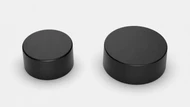
Quick answer: 28-400 and 38-400 are two different continuous-thread neck finishes, and they are not interchangeable. A jar with a 28-400 neck finish needs a compatible 28-400 closure, while a 38-400 jar needs a compatible 38-400 closure.
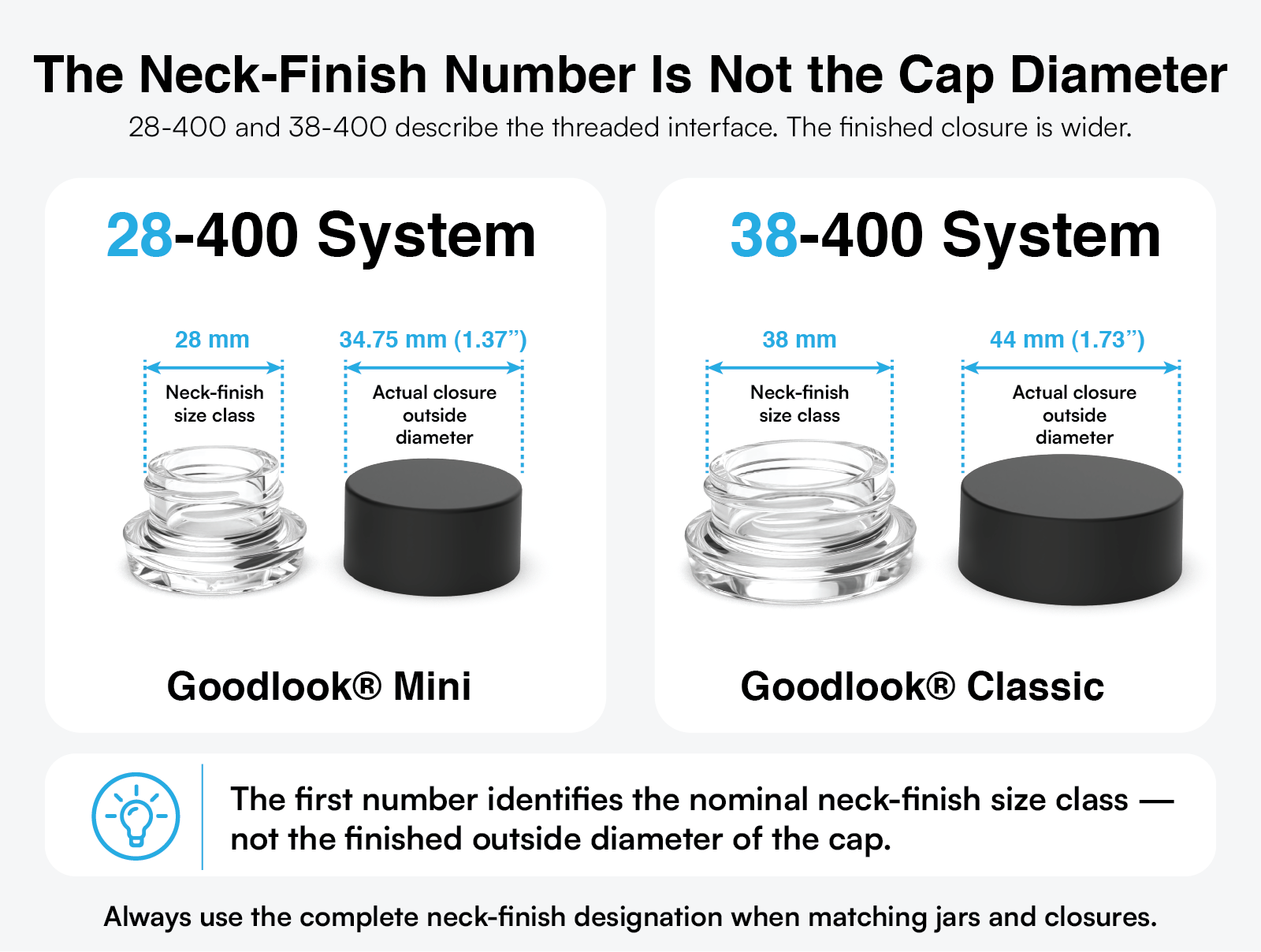
The first number identifies the nominal neck/thread size class in millimeters. The 400 identifies the continuous-thread finish style.
28-400
Goodlook® Mini
38-400
Goodlook® Classic
What Does 28-400 Mean?
A container neck finish describes the threaded interface where the jar and closure mate.
28
Identifies the nominal neck/thread size class in millimeters.
400
Identifies the continuous-thread finish style.
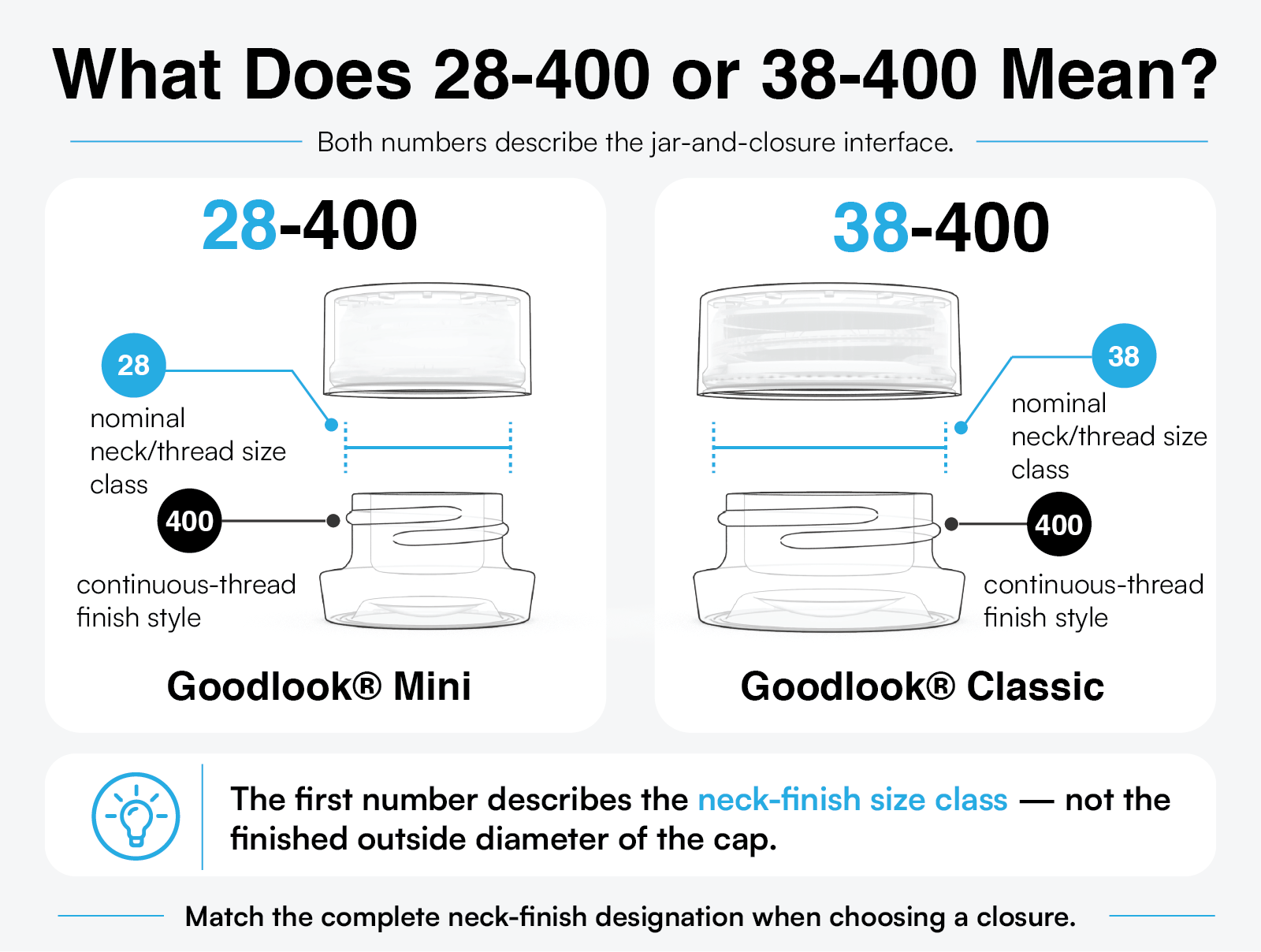
The number does not mean the finished cap itself is exactly 28mm wide.
Makerbaus's current 28-400 smooth child-resistant closure has an outside diameter of approximately 34.75mm, even though it mates to a 28-400 neck finish.
The neck-finish designation describes the jar-and-closure interface, not the total exterior width of the cap.
Goodlook® Mini uses 28-400
The Goodlook® Mini 3ml glass concentrate jar uses a 28-400 neck finish and pairs with the Makerbaus 28-400 child-resistant concentrate jar lid.
Mini is the more compact Goodlook format and is designed around a familiar small-format concentrate-packaging footprint. Makerbaus pairs this closure system with a 30mm lid-label format.
What Does 38-400 Mean?
The same naming system applies to 38-400:
38
Identifies the larger nominal neck/thread size class.
400
Identifies the same continuous-thread finish family.
Again, the first number is not the finished outside diameter of the cap.
Makerbaus's current 38-400 smooth child-resistant closure has an outside diameter of approximately 44mm.
Goodlook® Classic uses 38-400
The Goodlook® Classic 8ml glass concentrate jar uses a 38-400 neck finish and pairs with the Makerbaus 38-400 child-resistant concentrate jar lid.
Classic is the larger Goodlook format, designed around the common 7ml–9ml concentrate-packaging class. Makerbaus pairs the larger closure system with a 39mm lid-label format.
What Does the “400” Mean?
A 400 finish is a common continuous-thread finish.
A 28-400 closure is not the same as a 28-410 or 28-415 closure, and a 38-400 closure is not simply “any 38mm cap.”
Even when two components share the same nominal neck finish, production fit should still be verified because actual performance can depend on manufacturing tolerances, thread geometry, liner dimensions, application torque and the complete package configuration.
A shared neck-finish designation is the starting point for compatibility—not a substitute for testing.
28-400 vs. 38-400 at a Glance
| Feature | 28-400 | 38-400 |
|---|---|---|
| Goodlook jar | Mini 3ml | Classic 8ml |
| Common packaging class | Compact 3ml / 5ml-style | Larger 7ml / 8ml / 9ml-style |
| Makerbaus lid outside diameter | Approx. 34.75mm | Approx. 44mm |
| Makerbaus lid height | Approx. 17mm | Approx. 17mm |
| Makerbaus lid-label format | 30mm | 39mm |
| Branding area | Smaller | Larger |
| Grip area | Smaller | Larger |
| Neck-finish compatibility | 28-400 | 38-400 |
| Current Makerbaus liner | Foil-faced, foam-backed | Foil-faced, foam-backed |
| Closure mechanism | Push-down-and-turn CR design | Push-down-and-turn CR design |
The larger system is not automatically better. It solves a different packaging problem.
If you are still deciding which jar format makes sense for the product itself, see our concentrate jar size guide or our guide to choosing the best jar size for 1 gram of concentrate.
Are 28-400 and 38-400 Interchangeable?
No. A 28-400 closure should not be used on a 38-400 jar, and a 38-400 closure should not be used on a 28-400 jar.
They use different neck diameters and different closure dimensions. Trying to force the wrong closure onto a jar can create poor thread engagement, incorrect liner contact, sealing problems or unreliable opening and reclosure.
The closure should be specified from the jar's actual neck finish, not guessed from the jar's nominal volume.
Does every 3ml or 5ml jar use 28-400?
No. Many compact concentrate jars use 28-400, but milliliter capacity does not determine closure compatibility. Goodlook Mini uses 28-400; a third-party 3ml or 5ml jar should be checked individually.
Does every 7ml, 8ml or 9ml jar use 38-400?
No. Many larger concentrate jars use 38-400, and Goodlook Classic does, but another supplier's 7ml, 8ml or 9ml jar may use a different finish.
Why Choose the Larger 38-400 Closure?
A larger closure can offer practical advantages in branding, grip and package presence.
More branding area
The larger lid surface creates more room for logos, product names, symbols, warnings, batch information and other required copy.
Makerbaus pairs its larger closure system with a 39mm lid-label format, compared with the 30mm format used on the smaller system.
More gripping area
The larger outside diameter provides more surface area to hold and a larger turning radius.
That can make the package easier for some adults to grip, although actual opening effort still depends on the closure mechanism, application torque, push-down force and the complete package.
More package presence
The larger closure also contributes to the more substantial hand feel and retail presence of the Classic format.
Why Choose the Smaller 28-400 Closure?
The smaller system has different advantages:
- More compact package
- Smaller component footprint
- Less storage and staging space
- Easier portability
- Smaller lid-label format
- Compatibility with the Goodlook Mini system
For brands prioritizing compactness and pack-out efficiency, 28-400 can be the better fit.
Why Goodlook Uses Standard 28-400 and 38-400 Neck Finishes
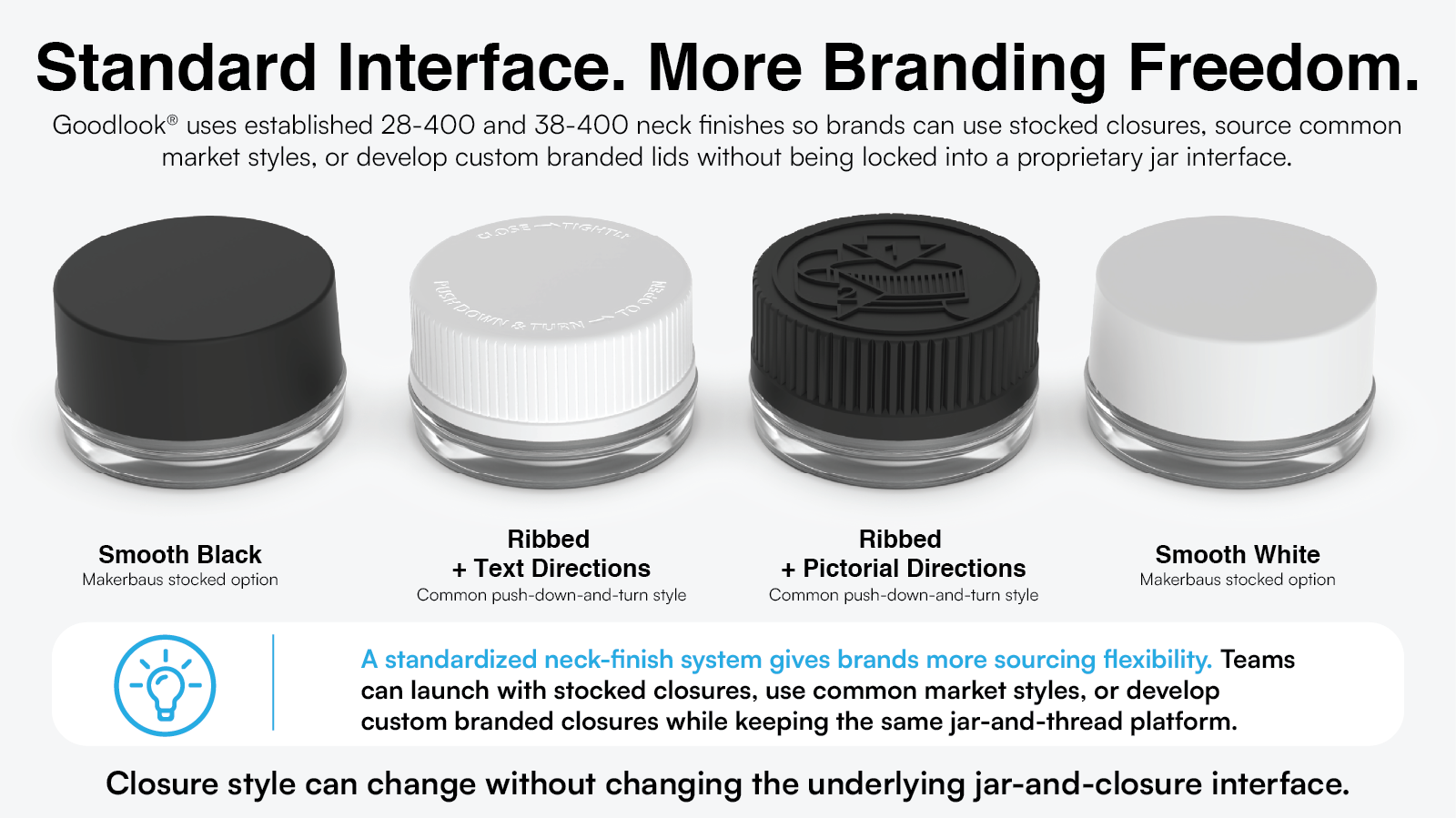
Goodlook® Mini and Classic were intentionally designed around established 28-400 and 38-400 continuous-thread neck finishes instead of a proprietary closure interface.
That gives packaging buyers more flexibility.
- More supplier options
- Less dependence on one proprietary closure
- Easier replacement sourcing
- Lower switching friction if a supplier changes
- A familiar specification for packaging vendors and buyers
Existing custom closures can stay valuable
This becomes especially important for brands that have already invested in a custom closure.
A company may have a 28-400 or 38-400 cap with:
If that custom closure uses the appropriate standard neck finish, the brand can evaluate it with a Goodlook jar instead of automatically starting over with a new cap.
The same principle can work in reverse. A brand that later changes jars may have a better chance of preserving its custom lid investment if both systems remain within the same established neck-finish family.
What can stay valuable?
What can stay familiar?
There is an important limit to that flexibility: a matching 28-400 or 38-400 designation does not automatically approve a new jar-and-cap combination.
The actual components still need to be validated for thread engagement, liner contact, application torque, opening/reclosure behavior and any applicable child-resistant requirements.
A child-resistant test result for one jar-and-closure combination also should not be assumed to transfer to a different jar merely because both jars use the same nominal neck finish.
How Child-Resistant Packaging Is Actually Evaluated
Continuous-thread push-down-and-turn closures are a long-established child-resistant packaging architecture, but a 28-400 or 38-400 neck finish is not itself child-resistant.
The neck finish describes the threaded interface. Child-resistant performance comes from the closure mechanism and the complete package configuration.

16 CFR Part 1700
The main U.S. federal reference is the Poison Prevention Packaging Act framework implemented through 16 CFR Part 1700.
16 CFR § 1700.15
Sets effectiveness specifications for special packaging.
16 CFR § 1700.20
Describes the child and adult testing procedures.
Under the current federal specifications, the applicable special packaging generally must achieve at least:
The child panel uses children ages 42–51 months. The senior-adult panel uses adults ages 50–70.
That is why child-resistant package design is not simply about making a cap difficult to open. The protocol balances child resistance with adult usability.
Why this matters in cannabis packaging
Cannabis remains regulated primarily at the state level, but many state cannabis programs use the federal PPPA/CPSC framework when defining acceptable child-resistant packaging.
- California recognizes packages tested and certified to the PPPA child-resistant standard and points licensees to 16 CFR 1700.15.
- Oregon requires qualified third-party child-resistant package certification for applicable cannabis products and uses the 16 CFR 1700 testing framework.
- Nevada requires cannabis sold at a cannabis sales facility to be placed in child-resistant packaging in accordance with 16 CFR Part 1700.
Other states use similar references, sometimes incorporating specific dated versions of the federal rules.
The exact requirements can vary by jurisdiction, cannabis product type and whether the package is single-use or expected to remain child-resistant after repeated opening.
Where ASTM D3475 fits
ASTM D3475, Standard Classification of Child-Resistant Packages, classifies child-resistant packages by the motions or mechanisms used to open them.
CPSC's Special Packaging Index uses that classification framework and identifies Type I as reclosable packaging with a continuous-thread closure.
But ASTM D3475 is a classification standard, not a replacement for the PPPA/CPSC performance test. ASTM itself explains that listing or classification does not mean a package has successfully passed the applicable child-resistant protocol.
ASTM also publishes D8233, a guide addressing packaging and labeling of consumer resin cannabis products.
The complete package matters
The test configuration includes more than the cap.
16 CFR § 1700.20 addresses package preparation, liner set and application torque for torque-dependent closures. That is another reason the jar, cap, liner and application conditions should be treated as one system.
So it would be inaccurate to say:
The better statement is:
Why the Liner Matters for Concentrates
Both current Makerbaus concentrate-jar closure systems use a foil-faced, foam-backed liner.
The liner sits between the closure and jar opening and has two practical roles in concentrate packaging.
1. Support the seal at the jar opening
The foil face provides the product-contact surface, while the foam backing adds compressibility behind it to help the liner conform against the jar opening when the cap is applied correctly.
Actual sealing performance still depends on the complete package, including jar finish, liner construction, compression, application torque, closure geometry and storage conditions.
2. Give sticky concentrate a more recoverable contact surface
Concentrates such as rosin, live resin and wax can contact the underside of a lid during handling, storage or transport.
A smooth foil-faced surface is much less porous than an exposed foam surface. If sticky concentrate gets onto that face, residue can be easier to scrape or recover rather than becoming embedded in a porous material.
Foil, foam and PTFE
Different liner materials solve different packaging problems.
Foil-faced, foam-backed liners
Foam liners
PTFE liners
Foil and PTFE should not be treated as identical materials, but both can be attractive where a smooth, less-stick-prone contact surface is desirable.
The correct liner depends on the closure design, sealing requirements, product chemistry and desired user experience.
For a deeper comparison of product-contact surfaces, compression backings, first-open seals, and reclosure systems, see our guide to foil vs. foam vs. PTFE concentrate jar liners.
30mm vs. 39mm Lid Labels
Closure size also affects the branding system.
30mm circle label
Used with the Mini / 28-400 closure system.
39mm circle label
Used with the Classic / 38-400 closure system.
The larger format gives brands more room for product names, branding, batch information, warnings and variable data.
For available options, see custom concentrate labels.
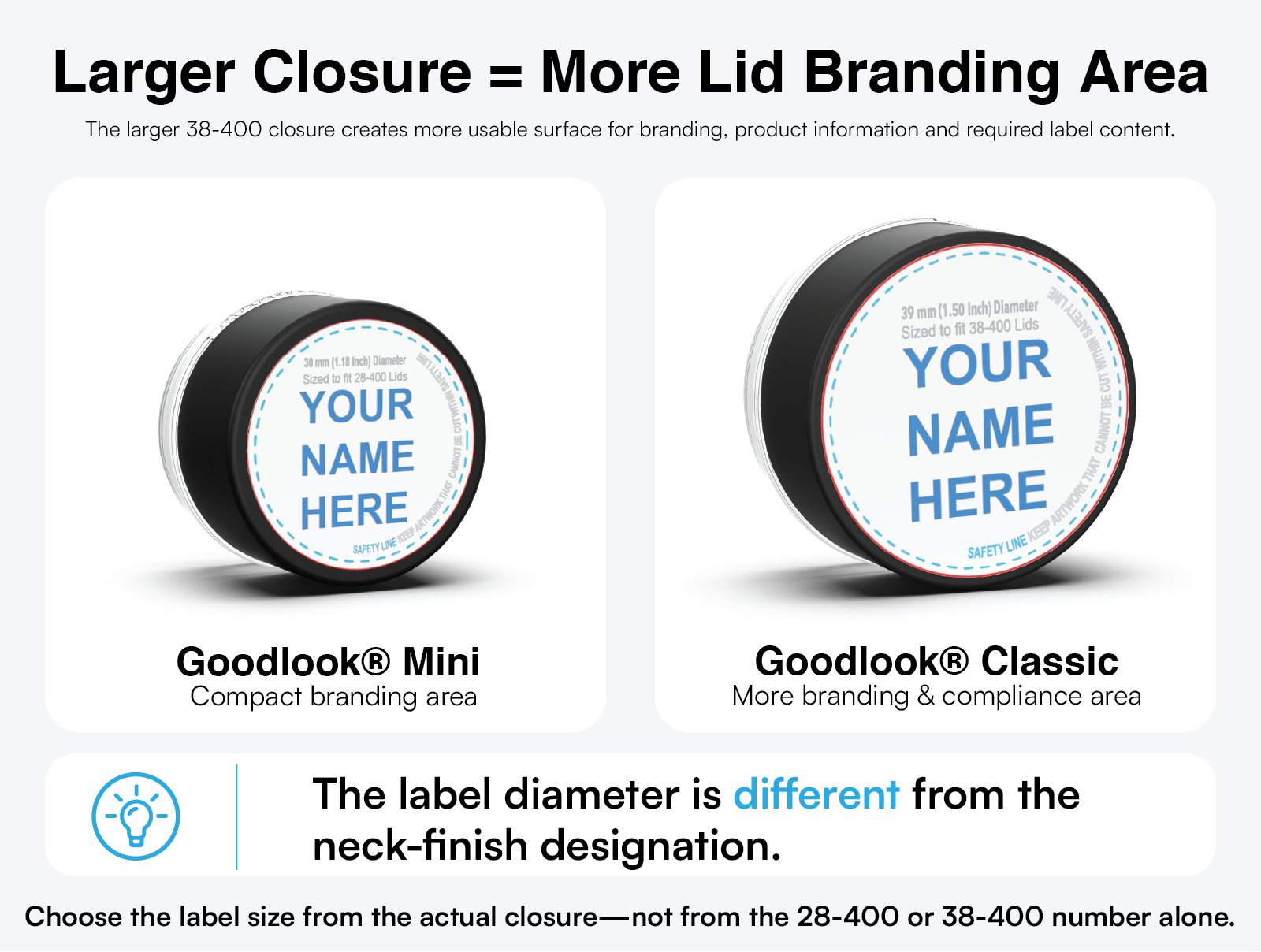
Label size is not the neck finish
A 30mm label does not mean the jar has a 30mm neck finish.
A 39mm label does not mean it has a 39mm neck finish.
The label dimension describes the printed label. The neck-finish designation describes the threaded jar/closure interface.
How to Verify a Jar and Lid Before Production
Before committing to production quantities:
- Confirm the jar neck finish. Do not infer it from jar volume.
- Confirm the closure neck finish. Match the complete designation.
- Test thread engagement. The closure should engage correctly and consistently.
- Verify application torque. Too little or too much can affect package performance.
- Verify liner contact. Confirm the liner interfaces correctly with the jar opening.
- Test opening and reclosure. Evaluate the actual finished package.
- Confirm label fit. Use the physical closure and correct dieline.
- Verify applicable requirements. Check the rules for the target product and jurisdiction.
- Test samples before production. Validate the actual components together.
Goodlook® Mini vs. Goodlook® Classic Closure Systems
| Feature | Goodlook® Mini | Goodlook® Classic |
|---|---|---|
| Jar capacity | 3ml | 8ml |
| Neck finish | 28-400 | 38-400 |
| Closure type | Push-down-and-turn CR design | Push-down-and-turn CR design |
| Closure OD | Approx. 34.75mm | Approx. 44mm |
| Closure height | Approx. 17mm | Approx. 17mm |
| Liner | Foil-faced, foam-backed | Foil-faced, foam-backed |
| Lid-label format | 30mm | 39mm |
| Primary advantage | Compact footprint | More branding and grip area |
| Magnifying glass base | Yes | Yes |
Goodlook® Mini
Compact 3ml jar with a 28-400 neck finish and 30mm lid-label format.
Goodlook® Classic
Larger 8ml jar with a 38-400 neck finish and 39mm lid-label format.
Frequently Asked Questions
What does 28-400 mean on a cap?
28 identifies the nominal neck/thread size class in millimeters, while 400 identifies the continuous-thread finish style.
What does 38-400 mean?
38 identifies the larger nominal neck/thread size class, while 400 identifies the same continuous-thread finish family.
Will a 28-400 cap fit a 38-400 jar?
No. They are different neck-finish sizes.
Will a 38-400 cap fit a 28-400 jar?
No.
Does every 5ml concentrate jar use a 28-400 lid?
No. Verify the actual jar neck finish.
Does every 9ml concentrate jar use a 38-400 lid?
No. Jar capacity does not determine neck finish.
What lid fits Goodlook Mini?
Goodlook Mini uses a compatible 28-400 closure.
What lid fits Goodlook Classic?
Goodlook Classic uses a compatible 38-400 closure.
Is a 38-400 lid easier to open?
Its larger diameter provides more gripping surface and turning radius, which may help some adults, but actual opening effort depends on the complete closure and package setup.
What size lid label does Makerbaus use with 28-400?
Makerbaus uses a 30mm lid-label format with the Mini / 28-400 system.
What size lid label does Makerbaus use with 38-400?
Makerbaus uses a 39mm lid-label format with the Classic / 38-400 system.
Does a child-resistant lid make the entire jar package compliant?
Not by itself. Child-resistant performance applies to the tested package configuration, and cannabis packaging requirements vary by jurisdiction.
Do Makerbaus concentrate lids include liners?
Yes. The current 28-400 and 38-400 Makerbaus concentrate-jar closures use foil-faced, foam-backed liners.
Are 28-400 and 38-400 proprietary Makerbaus threads?
No. Goodlook uses established continuous-thread neck-finish families rather than proprietary closure interfaces.
Can I use my own custom 28-400 or 38-400 closure on a Goodlook jar?
Potentially. One reason Goodlook uses established neck finishes is to preserve that option. But the actual custom closure, liner, jar and application must be tested together before production. Do not assume an existing child-resistant test result transfers to a different jar automatically.
The Bottom Line
28-400 and 38-400 are different continuous-thread neck finishes.
Goodlook® Mini uses 28-400. Goodlook® Classic uses 38-400.
28-400 provides:
- a more compact footprint
- smaller lid-label format
- efficient staging and storage
- compatibility with Goodlook® Mini
38-400 provides:
Makerbaus intentionally chose established neck-finish families instead of proprietary jar/closure interfaces so brands can retain more sourcing flexibility—and, in some cases, preserve investments in their own custom molded or decorated closures.
But standardized does not mean automatically compatible.
Sources & Technical Notes
- 16 CFR § 1700.15 — Poison prevention packaging standards. U.S. Electronic Code of Federal Regulations.
- 16 CFR § 1700.20 — Testing procedure for special packaging. U.S. Electronic Code of Federal Regulations.
- U.S. Consumer Product Safety Commission — Special Packaging Index. CPSC explains the ASTM D3475 package classifications and notes that CPSC does not approve or endorse packages listed in the index.
- ASTM D3475-20 — Standard Classification of Child-Resistant Packages. ASTM states that classification/listing is not itself evidence that a package has passed the applicable PPPA testing protocol.
- ASTM D8233-19 — Standard Guide for Packaging and Labeling of Consumer Resin Cannabis Products.
- California Department of Cannabis Control — Child-resistant packaging.
- Oregon Liquor and Cannabis Commission — Packaging & Labeling FAQ.
- Nevada Administrative Code § 678B.596 — Requirements for packaging of cannabis and cannabis products.
Compliance note: these sources explain general packaging standards and representative state requirements. Cannabis packaging requirements vary by jurisdiction and can change. This guide is not a 50-state compliance determination and does not represent package-specific certification of a Goodlook® jar/closure combination.
Package-performance note: neck-finish compatibility, sealing behavior, liner performance and child-resistant performance depend on the complete package configuration and application conditions. Validate the actual jar, closure and liner combination before production.
Tags: