If concentrate reaches the underside of a lid, the customer wants to recover the product—not leave part of the purchase stuck in the packaging. That makes the liner more than a small component hidden inside the cap.
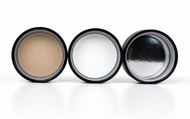
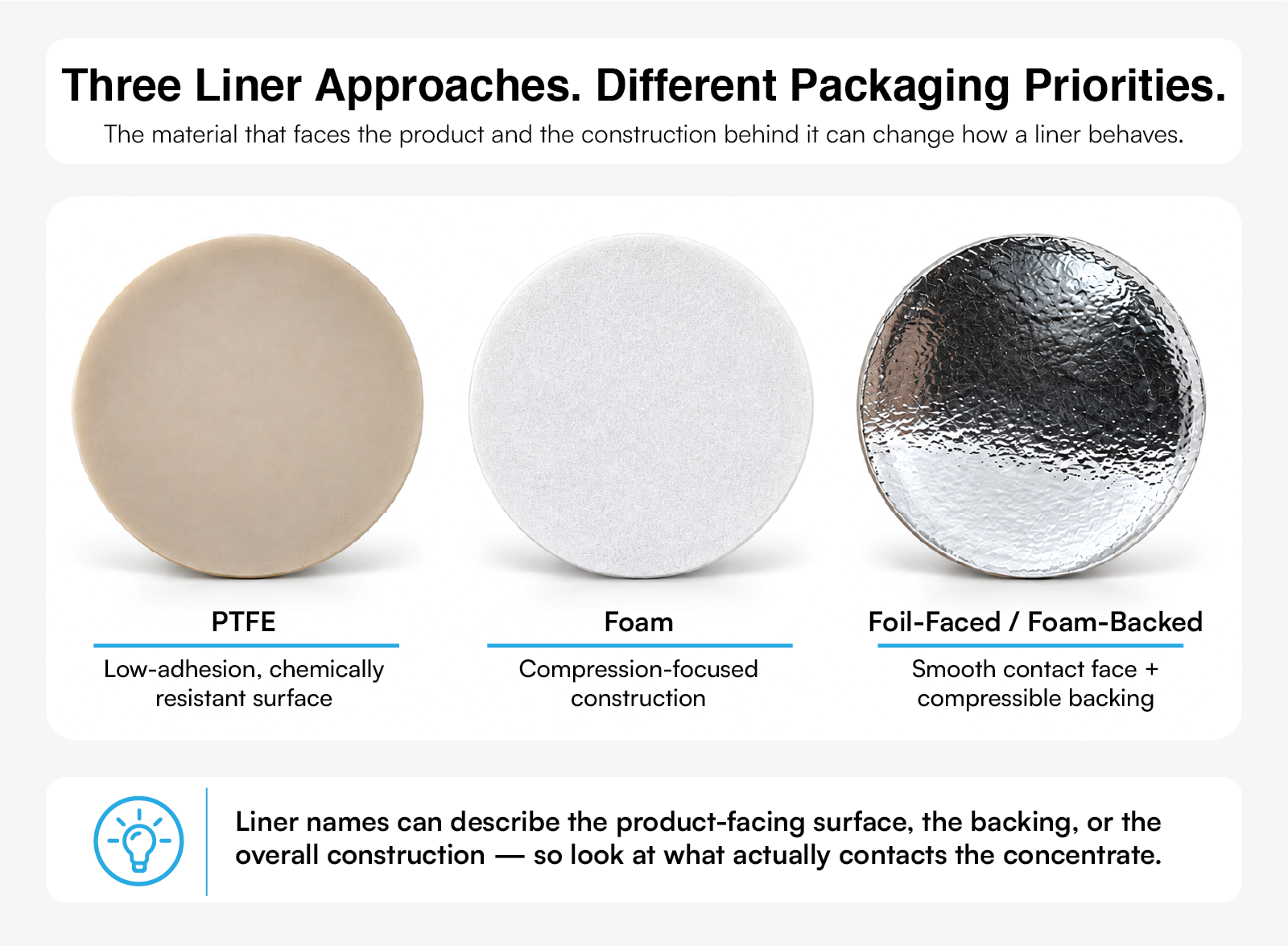
There is also an important catch: foil, foam and PTFE are not always three separate, mutually exclusive constructions. A liner can have a PTFE product-contact face and a foam backing. A foil-containing liner can be a compression liner or part of a different sealing system.
Makerbaus's current 28-400 lids and 38-400 lids use foil-faced, foam-backed liners. The foil is the product-contact face; the foam backing provides compressibility behind it. Here is how to evaluate that construction alongside other liner systems without confusing a material choice with a guaranteed package result.
What Is a Cap Liner?
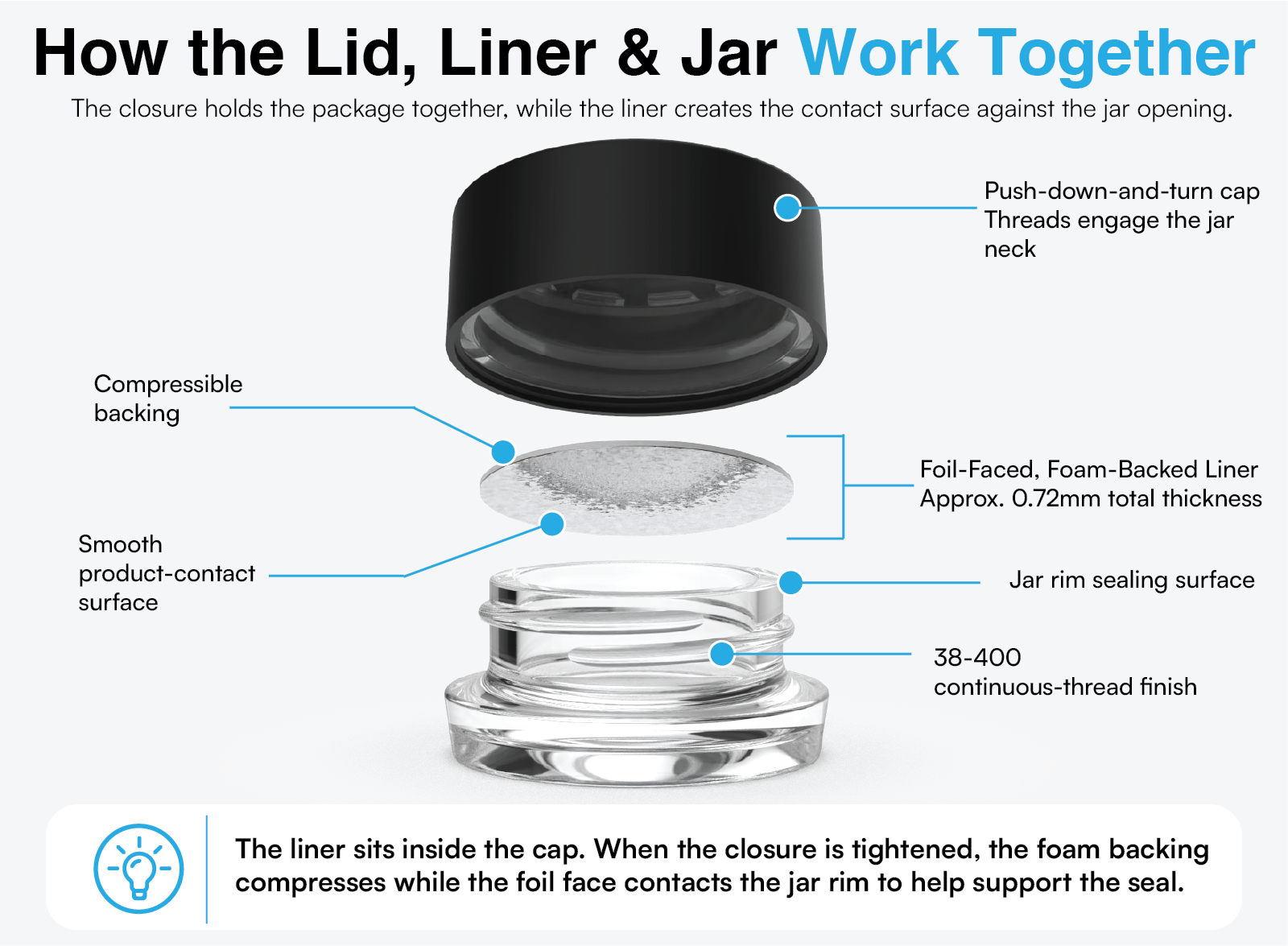
A cap liner is the disc or layered insert inside a closure that meets the jar's sealing surface. In a lined screw-cap package, tightening the cap presses that liner against the rim. Compression liners use that contact to help form the seal.
The threads and liner have different jobs:
The threads hold the closure onto the jar. The liner helps form the contact interface at the jar rim.
A liner can also provide a product-facing barrier, while some sealing systems create a separate bond to the container opening. Those functions depend on the construction; not every liner provides tamper evidence or works the same way after opening.
For buyers, the useful question is not simply, “Does the cap have a liner?” It is, “Which liner is installed, how does it seal, and what happens when the package is opened and closed again?”
Why the Product-Contact Surface Matters for Concentrates
Our packaging-design priority is straightforward: a small amount of sticky product left on the liner still matters to the person who paid for it.
When evaluating rosin, live resin, wax or sauce-rich concentrates, consider what happens if product reaches the lid during handling or transport. Does it lift away cleanly? Does it smear into surface texture? Can the customer recover it without damaging the liner?
A smooth facing may offer a better recovery experience than an exposed rough or porous surface. That is a practical design consideration—not proof that every foil liner releases every concentrate better than every foam liner.
Smoothness, absorption and adhesion are different properties. A surface does not have to absorb the product for sticky residue to remain attached. A meaningful comparison should examine both the amount left behind and the condition of the liner afterward.
Our goal is to choose packaging that supports sealing and product recovery together, rather than optimizing one while ignoring the other.
Product-Contact Face vs. Backing: Read the Whole Construction
Liner names are often shorthand. The word on the quote may describe the facing, the core or a particular product family.
The facing is the exposed surface toward the jar contents. The backing supports it and can provide compression. Other layers may join the structure or provide a specific barrier or sealing function.
For example, Qorpak describes a PTFE-faced liner backed by a low-density foam core between two solid polyethylene layers. It contains both PTFE and foam; those materials perform different jobs.
That is why “PTFE versus foam” can be an incomplete comparison. You might actually be comparing a polyethylene-faced foam liner with a PTFE-faced foam liner.
Ask suppliers to identify the exposed face, backing, thickness and sealing method. For a foil-containing laminate, also ask whether a coating or film covers the metal. A shiny appearance is not a complete material specification.
Choose the surface that touches the product and the structure that makes the package work.
Foil-Faced Liners: Smooth Contact + Compressible Backing
The current Makerbaus 28-400 and 38-400 concentrate closures use a foil-faced liner with a white foam backing.
Physical inspection of current stock shows:
- a shiny foil product-contact face
- a white foam backing
- an overall liner thickness of approximately 0.72mm
- a backing surface that appears smooth / skin-faced rather than openly porous
The exact foam polymer and supplier construction name have not yet been verified, so Makerbaus should not call it F217, PE foam or another named commercial liner construction without the supplier specification.
Functionally, the two layers serve different purposes:
- Foil face: provides the smooth surface that faces the concentrate.
- Foam backing: provides compressibility so the liner can conform against the jar rim when the closure is applied.
The concentrate contacts the foil face; the foam sits behind it to help the liner compress and support the seal.
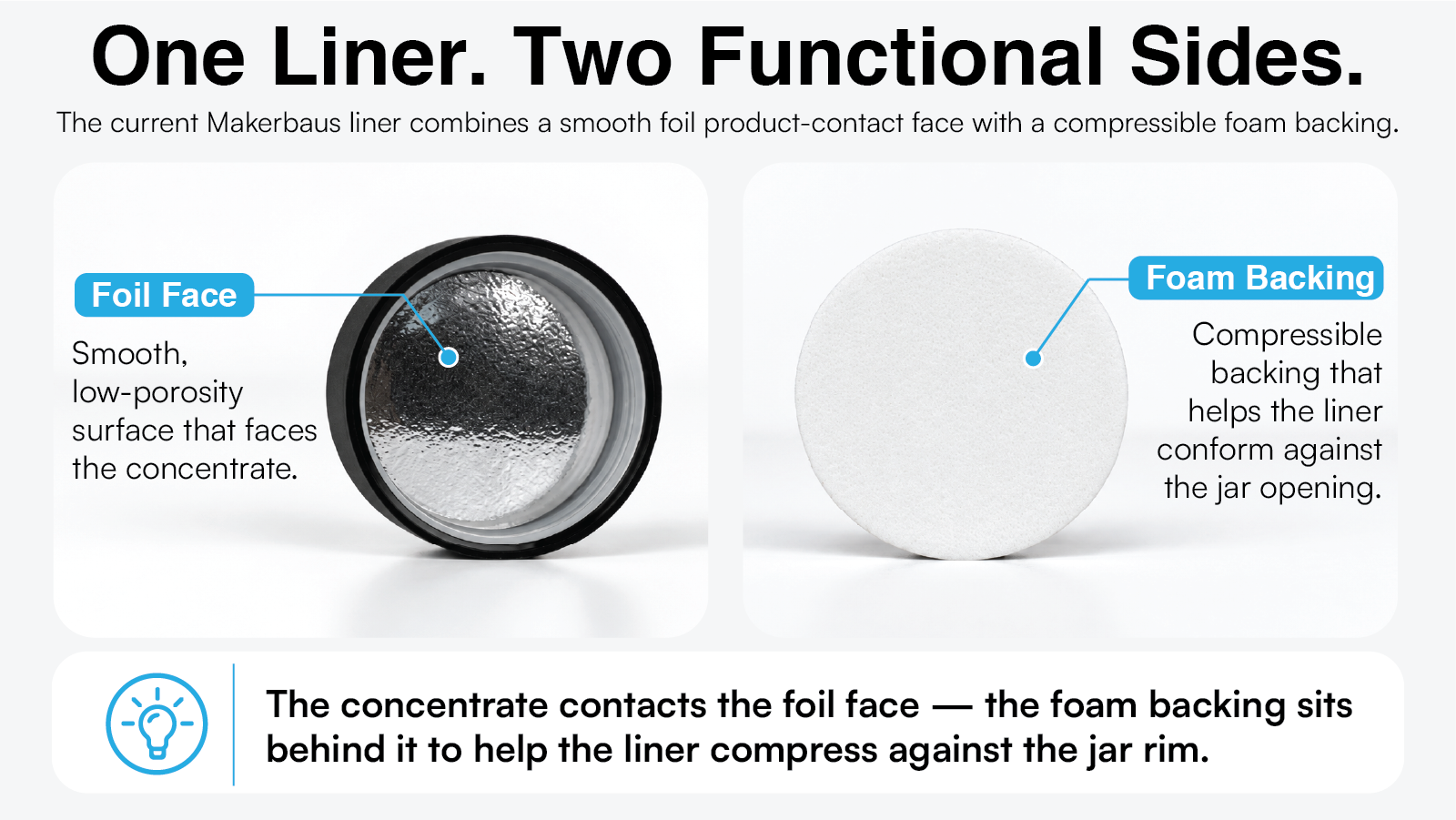
That is an important distinction. A foam-backed liner does not mean the concentrate is touching exposed foam.
For concentrate packaging, the foil face also supports Makerbaus's recovery-focused design priority. If sticky concentrate reaches the underside of the lid, a smooth low-porosity face can be easier to scrape or recover from than an exposed rough or porous surface.
That does not make foil universally nonstick. Actual adhesion depends on the concentrate, the surface treatment and the complete liner construction. The installed liner should be tested with the real product rather than assuming performance from appearance alone.
A foil layer also does not tell you whether a liner is induction-compatible. Foil-faced compression liners and induction-seal laminates are different systems, discussed below.
Foam Liners, F217 and Polyethylene Foam
“Foam liner” does not automatically mean the concentrate touches raw, absorbent foam.
TekniPlex describes its F-217 construction as a foamed core with solid outer skins. Those skins provide smooth contact surfaces. Its product family includes different densities, thicknesses and material options.
Foam's role is often mechanical: it provides a compressible structure between the cap and jar rim. Pres-On also describes three-layer polyethylene liners intended for compression sealing and resealing, with thickness selected to suit the cap-and-container design.
That makes it misleading to group every foam-containing liner into a single “bad for concentrates” category.
An exposed rough or porous face may make sticky residue harder to recover. But a solid-film-faced foam liner is a different surface and deserves its own evaluation. Product adhering to that film is also not evidence that it has soaked into the foam core.
Foam backing is not the same thing as exposed foam at the product surface.
For a purchase specification, record the facing as well as the core. That makes future supplier comparisons much more meaningful than requesting only “a foam liner.”
PTFE Liners: Release Properties and Chemical Resistance
PTFE means polytetrafluoroethylene. Chemours describes PTFE products as having low-friction characteristics and chemical resistance, and identifies nonstick behavior among the properties of its fluoropolymer coatings.
Teflon™ is a Chemours brand, not the generic name for every PTFE liner. The brand covers multiple fluoropolymer families, including PTFE, FEP and PFA. Use the specific material designation when comparing supplier specifications.
For concentrate packaging, PTFE is worth evaluating when the product-contact priorities include release behavior and chemical compatibility. Those properties are a reason to test it—not a guarantee of zero residue or suitability for every formulation.
A PTFE liner also need not be a solid PTFE disc. The foam-backed construction described by Qorpak demonstrates how a release-facing material can be combined with a resilient backing.
Ask for the exact facing thickness, backing, suitable applications and documentation for the intended product contact. Also confirm availability in the chosen closure and compare actual quotes. A material's reputation is not a substitute for a complete specification or a finished-package trial.
Foil vs. Foam vs. PTFE at a Glance
This table compares typical cap-retained liner approaches, not induction seals or guaranteed concentrate-performance rankings.
| Selection question | Foil-faced construction | Foam-based construction | PTFE-faced construction |
|---|---|---|---|
| What surface faces the product? | Foil or a specified coating/facing over it | Often solid polymer skins; verify the construction | PTFE facing |
| Where does compression come from? | Backing and overall laminate | Foam core | Backing, when present |
| What is the main reason to evaluate it? | Smooth contact face and seal support | Compression, conformity and resealing | Release properties and chemical resistance |
| What needs special attention? | Surface treatment, backing and product compatibility | Actual exposed skin—not just the word “foam” | Facing, backing and complete liner compatibility |
| Does the name prove easy residue recovery? | No | No | No |
| Does it automatically provide tamper evidence? | No | No | No |
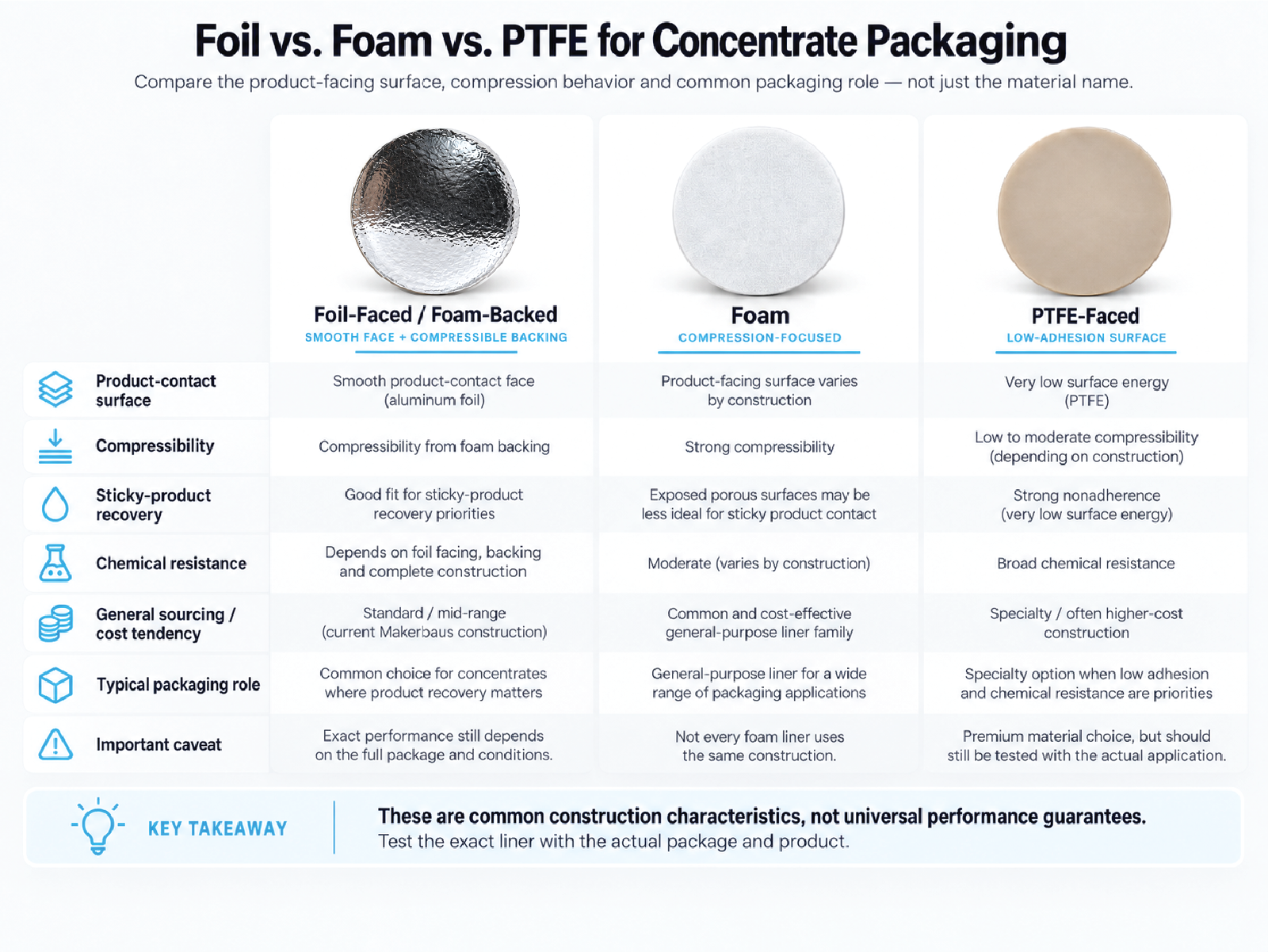
The most useful comparison is between identified supplier grades tested in the same package—not three generic material names.
Foil-Faced Cap Liner vs. Induction Foil Seal
These can look similar before use, but they perform different jobs.
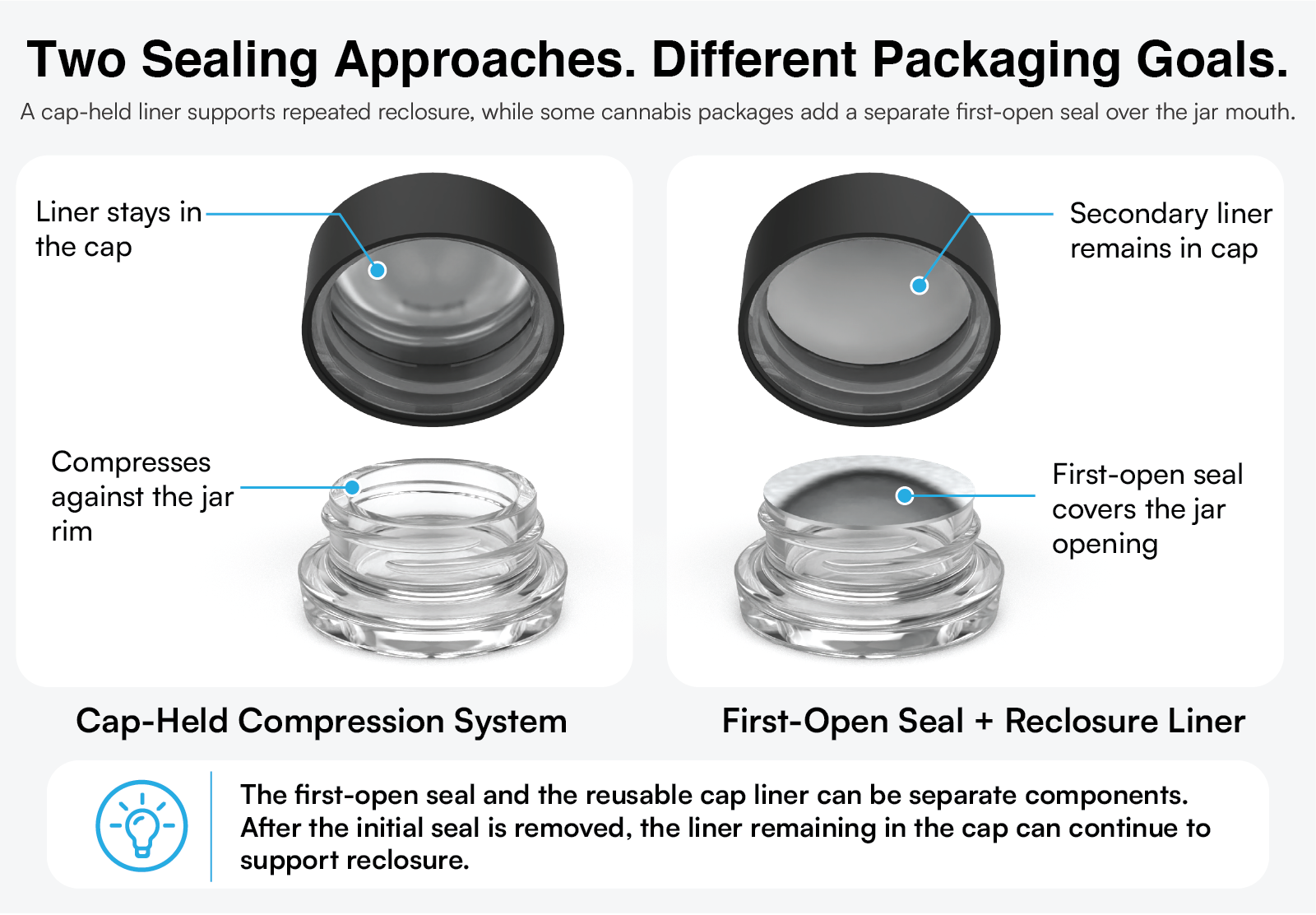
A cap-held compression liner supports reclosure
A cap-retained compression liner stays inside the closure and is pressed against the jar rim as the cap is secured. Resealing depends on that liner making suitable contact again when the cap is reapplied.
This is the basic role of the current Makerbaus foil-faced, foam-backed liner: the foil provides the product-contact face while the foam backing supplies compressibility behind it.
An induction seal creates a separate first-open barrier
Induction sealing uses equipment to heat a foil-containing sealing laminate. That activates a seal layer that bonds the inner membrane directly to the container lip.
The customer encounters that membrane across the jar opening after removing the cap. When properly specified and applied, it can provide a visible first-open barrier or tamper-evident experience.
A silver-looking liner inside a cap is not automatically an induction seal.
Many packages use both a first-open seal and a secondary reclosure liner
This distinction is especially important in cannabis packaging.
A package does not always choose between either a cap-held liner or an induction seal. Many configurations use both:
- a bonded first-open membrane across the jar opening, and
- a separate secondary liner that remains in the cap for repeated reclosure after the first-open membrane is removed.
Selig documents two-piece induction constructions that leave a separate reseal backing in the closure after the inner seal is removed.
Makerbaus has also encountered cannabis packaging systems built around this same general two-stage idea: a first-open seal at the jar mouth plus a reusable liner retained in the cap.
The practical question is therefore not simply:
“Does this package use induction?”
It is:
What creates the first-open barrier, and what remains in the cap to support reclosure afterward?
For a project requiring a bonded first-open seal, obtain the exact liner/seal specification and confirm:
- what membrane bonds to the jar
- what, if anything, remains in the closure
- what equipment and settings are required
- how the package reseals after first opening
Do not assume Makerbaus's current foil-faced, foam-backed liner is induction-compatible without supplier documentation.
Pressure-Sensitive Liners Are Another System
A pressure-sensitive seal uses an adhesive layer that transfers or adheres to the container rim through pressure/contact. It does not rely on the same heating process as induction sealing.
As with induction systems, the complete construction matters more than the shorthand name.
Some cannabis packaging configurations use a first-open pressure-sensitive seal together with a separate secondary liner retained in the cap, so the customer removes the initial seal while the remaining cap liner continues to support reclosure.
Other pressure-sensitive constructions may be one-piece or intended for very different products, so the supplier specification must identify what actually remains in the cap after opening.
The Pres-On example cited here uses adhesive-coated polystyrene foam, is intended for dry products, and is specifically not recommended by the manufacturer for liquids. That example should not be treated as a default concentrate solution.
For concentrate packaging, verify:
- the adhesive and product-contact suitability
- whether the first-open seal stays bonded to the jar or transfers from the cap
- whether a secondary reclosure liner remains in the closure
- the intended product type and storage conditions
The broader lesson is the same:
Neck finish, product-contact facing, compression backing, first-open seal and reclosure liner are separate package specifications.
Can Changing the Liner Affect Child-Resistant Performance?
It can affect the package configuration that needs to be evaluated.

The federal special-packaging test procedure, 16 CFR § 1700.20, specifically accounts for closure-liner settling and application torque when packages are prepared for testing. It also includes liner material in package-identification information.
Our practical recommendation is to treat a different liner thickness, backing or construction as a package change that needs review—not as an automatically interchangeable accessory.
For a package relying on documented child-resistant performance, ask the supplier or testing laboratory whether the proposed configuration is covered or needs additional evaluation. A supplier's answer should relate to the actual jar, closure and liner combination.
For the larger explanation, see our 28-400 vs. 38-400 concentrate jar closure guide.
What Liner Should You Evaluate for Your Concentrate?
The following are selection priorities, not laboratory rankings of liner materials.
Rosin
Start with the product-contact experience: how much reaches the lid, how it releases, and whether the facing stays intact. Foil-faced and PTFE-faced constructions are candidates to evaluate, but neither should be selected without checking the seal and the actual formulation.
Live resin and sauce-rich products
Put extra attention on migration and leakage when the product is mobile. Include realistic storage orientations in testing rather than evaluating only an upright jar immediately after filling. The facing, any adhesive or coating, and the complete seal all deserve consideration.
Diamonds, badder, wax and hash
Do not assign a liner solely from the product name. A dry crystalline fill and a sauce-containing fill may present different contact conditions. Consider surface adhesion, particles at the rim, available headspace and the customer's access to the product.
The liner decision should complement the jar decision. Our concentrate jar size guide explains the broader system; the one-gram concentrate packaging guide compares compact and larger formats.
How to Evaluate a Liner Before Production
Use the supplier's requirements and a documented test plan for the actual product. The steps below are a practical screening framework, not a substitute for required compliance testing or a validated shelf-life study.
1. Identify the complete package
Record the jar, closure and liner supplier grades. Include facing, backing, diameter, thickness, production lot and intended sealing method. Keep a retained sample or photograph so that later comparisons use the same configuration.
Request product-contact suitability information for the whole laminate, including relevant coatings and adhesives—not only the headline material.
2. Reproduce the intended filling and capping process
Use the actual concentrate and fill amount. Apply the cap using the specified process and torque. For induction systems, document the supplier-approved settings and verify the bond around the rim.
Compare candidate liners under equivalent conditions. A result from a different cap or application process is not a clean material comparison.
3. Represent storage and distribution
Include upright storage and foreseeable side or inverted orientations. Define the temperatures, durations and handling conditions relevant to the distribution plan, rather than choosing an arbitrary stress test.
Use multiple packages and retain comparison samples. One attractive example is useful for photography, but not enough to establish consistent production behavior.
4. Inspect the package and contact surfaces
Look for leakage, product migration, loose liners, swelling, wrinkling, cracking, staining or separation between layers. Document observations rather than treating every cosmetic change as the same failure.
For residue recovery, assess what remains after representative handling and whether the face stays intact. Recovery should not require cutting, heating or abrading the liner. Material damage or particles in the product are reasons to stop and investigate.
5. Evaluate reclosure and product compatibility
Check the package after opening and reclosing, not just at first opening. For a first-open induction or pressure-sensitive system, document what membrane was removed and evaluate the secondary liner that remains in the cap separately.
Arrange appropriate compatibility or migration assessment when the application warrants it. Visual inspection alone cannot establish chemical suitability, and tasting or consuming exposed product is not a validation method.
6. Set acceptance criteria before approving production
Decide what counts as an acceptable seal, intact facing, usable reclosure and satisfactory recovery. Review any changes affecting documented child-resistant performance with the appropriate supplier or laboratory.
Keep the approved specification and test record together so future purchasing does not substitute a merely similar-looking liner.
A liner specification sheet cannot replace a product-in-package evaluation.
Why Makerbaus Uses Foil-Faced, Foam-Backed Liners
For the current Goodlook 28-400 and 38-400 closure systems, Makerbaus uses a foil-faced, foam-backed liner.
The construction aligns with two concentrate-packaging priorities:
Smooth product-contact surface
The foil face gives sticky concentrate a smooth, low-porosity surface at the underside of the lid. If product reaches that surface during handling or transport, the goal is for it to remain accessible rather than disappear into an exposed porous material.
Compressibility at the jar rim
The foam backing gives the liner resilience so it can compress against the jar opening when the closure is applied. That helps the liner conform to the sealing surface rather than relying on a rigid disc alone.
The current liner measures approximately 0.72mm total thickness on a stock sample. Because the exact foam chemistry and supplier laminate designation are not yet documented, Makerbaus should describe it by the verified construction rather than assigning it a specific F217 or PE-foam product name.
The same liner philosophy is used across Goodlook® Mini and Goodlook® Classic.
This does not mean foil is the only appropriate liner for concentrates. PTFE-faced constructions can be attractive for specialized programs where low adhesion and chemical resistance are priorities. Foam-based constructions can also work well when the product-facing skin and complete package are appropriate.
The packaging decision should remain:
Choose the facing, backing and sealing method that work with the actual product and complete package.
Explore Makerbaus concentrate jar lids.
Frequently Asked Questions
What is the liner inside a concentrate jar lid?
It is the insert or laminate that meets the jar rim and contributes to the closure interface. Compression liners and bonded inner seals perform that role differently.
Is foil better than foam for rosin?
Not as a blanket rule. Evaluate the actual exposed surfaces and the finished package. A smooth foil-facing may suit a recovery-focused design, but many foam-based liners also have solid skins.
Does foam absorb concentrate?
The label alone does not answer that. F217-type constructions can have solid outer skins over a foamed core. Distinguish product adhering to the facing from material entering the backing.
Is a PTFE liner made entirely from PTFE?
Not necessarily. PTFE may be the facing over foam or another backing. Qorpak's documented foam-backed PTFE construction is one example.
Is PTFE the same as Teflon?
PTFE is a polymer designation. Teflon™ is a Chemours brand used for several fluoropolymer product families. Specify the material and supplier grade.
Is a foil liner an induction seal?
Not necessarily. An induction seal is a specific foil-containing laminate bonded to the container with an induction process. Appearance alone does not identify it.
What liner does Makerbaus use?
Current Makerbaus 28-400 and 38-400 concentrate closures use a foil-faced, foam-backed liner. The foil is the product-contact face and the white foam backing provides compressibility. Current stock measures approximately 0.72mm total liner thickness. The exact foam polymer and supplier laminate designation have not yet been verified, and the liner should not be described as induction-compatible without supplier documentation.
Can I change the liner and keep the same cap?
Potentially. Confirm the new liner's fit and compression, then review the complete package and any documented performance requirements. Liner construction and thickness matter.
Does a liner guarantee terpene retention or shelf life?
No material name establishes a finished-package shelf-life result. This guide does not report a Goodlook preservation study or a quantified comparison among liners.
Can an induction-sealed concentrate jar still have a liner in the cap?
Yes. Many two-piece induction systems use a bonded first-open membrane at the jar mouth while a separate secondary liner remains in the closure for reclosure after the membrane is removed. Exact construction varies by supplier.
Can a pressure-sensitive first-open seal also use a secondary cap liner?
It can. Some cannabis packaging configurations pair a first-open pressure-sensitive seal with a separate liner retained in the closure, while other pressure-sensitive systems use different constructions. Verify the exact layer stack and what remains after first opening.
The Bottom Line
The best concentrate-jar liner is the one that works with the product and the complete package—not simply the one with the most appealing material name.
The most useful way to compare liners is by four questions:
- What surface actually touches the concentrate?
- What provides compression against the jar rim?
- How does the package create its first-open and reclosure seal?
- How does the actual product behave in the finished package?
Makerbaus currently answers the first two with a foil-faced, foam-backed liner: the foil provides the smooth product-contact surface, while the foam provides compressibility behind it.
PTFE-faced and other liner constructions can be worthwhile for specialized programs, but no material name replaces finished-package testing.
Choose by facing, backing, sealing method and verified package behavior.
Sources & Technical Notes
- Makerbaus — 28-400 Concentrate Jar Lid. Current product specifications and foil-liner description; foam backing and approximate thickness were later confirmed by physical inspection of current Makerbaus stock.
- Makerbaus — 38-400 Concentrate Jar Lid. Current product specifications and foil-liner description.
- TekniPlex — F-217 Liners. Manufacturer construction overview describing solid outer skins around a foamed core.
- Qorpak — Compound Vials / PTFE-Faced Liner Example. Example of a PTFE face backed by a foam core between solid LDPE layers.
- Chemours — Teflon™ PTFE Coatings. General PTFE low-friction, release and chemical-resistance properties.
- Chemours — Teflon™ Fluoropolymer Resins. Distinguishes PTFE and other fluoropolymer families under the Teflon™ brand.
- Pres-On — PE Foam Liner. Compression and reseal liner example; demonstrates the need to match thickness to the cap-and-container design.
- Enercon Industries — How Induction Sealing Works. Induction heating and bonding mechanism.
- Selig Group — FoilSeal™. One- and two-piece induction constructions, including designs that leave a separate reseal backing in the cap.
- Pres-On — Pressure Seal. Pressure-activated adhesive liner example and manufacturer application limitations.
- 16 CFR § 1700.20. Special-packaging test procedure, including package-preparation considerations such as liner set and application torque.
- Qorpak — Cap Materials & Liner Descriptions. Examples of distinct liner constructions and application considerations.
Technical note: Material descriptions are not finished-package guarantees. Confirm the exact liner specification, product-contact suitability and package performance for the intended application. This guide does not establish a Goodlook® child-resistant certification, regulatory approval, leakproof rating or shelf-life claim.
Tags: