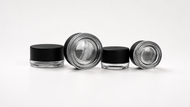
There is no single correct concentrate jar size based only on gram weight. Compact 3ml and common 5ml-style jars are frequently used for single-gram fills, while 7ml, 8ml and 9ml-style packages provide more internal room, branding area and package presence.
The tradeoff is that a larger internal volume also leaves more unused headspace around the same small product fill. If two jars are filled and capped under the same ambient conditions, the jar with more air space will generally enclose more oxygen. Because oxygen can participate in degradation pathways affecting cannabinoids and terpenes, headspace can be a meaningful packaging consideration alongside seal quality, temperature, light and storage time.
Quick Concentrate Jar Size Comparison
| Jar format | Common role | Typical closure family | Why a brand may choose it |
|---|---|---|---|
| 3ml | Compact single-gram-style packaging | 28-400 in Goodlook® Mini | Less unused internal volume, compact footprint |
| 5ml | Familiar small concentrate format | Often 28-400 | Established packaging ecosystem, more internal room |
| 7ml | Mid-size concentrate format | Varies by supplier | More room, branding area and package presence |
| 8ml | Goodlook® Classic format | 38-400 | Larger 7–9ml packaging class with added capacity |
| 9ml | Larger common concentrate format | Often 38-400 | Larger fills, more headspace and branding surface |
What Does “5ml Concentrate Jar” Actually Mean?
A milliliter measures volume. A gram measures mass. That distinction matters more than it sounds.
A gram of one concentrate may occupy a different amount of physical space than a gram of another. Density, consistency, air inclusion, crystal structure, sauce content and the way the product is deposited into the jar can all affect how much volume a given weight occupies.
This is why simple charts that claim every 5ml jar holds exactly the same number of grams are misleading. A nominal jar volume tells you the approximate internal capacity of the container. It does not tell you how much headspace will remain, how easy the product will be to access, how large the jar will be externally, which lid it uses, how much branding area is available, or whether it fits an existing insert or box.
What Size Concentrate Jar Is Best for 1 Gram?
A compact 3ml jar or common 5ml-style jar is often a practical starting point for a 1-gram concentrate fill, but the actual product should always be tested in the actual jar before production.
For a deeper look at one-gram packaging specifically, see our guide to choosing the best jar size for 1 gram of concentrate.
Compact packaging
A jar with an internal cavity sized closer to the intended fill can offer:
- less unused internal volume
- less headspace around the same fill
- a more compact product-to-package ratio
- easier carrying, storage and handling
- a more intentional presentation for a small fill
Larger-format packaging
A brand may intentionally use a larger jar for the same one-gram fill to gain:
- more lid and sidewall area for labels
- a larger visual footprint at retail
- more room around the concentrate
- easier access for some consistencies
- compatibility with an existing larger-format system
The best choice depends on whether the brand is optimizing primarily for compactness and headspace, or for branding area, presentation, access and packaging-system compatibility.
Why Headspace Matters in Concentrate Packaging
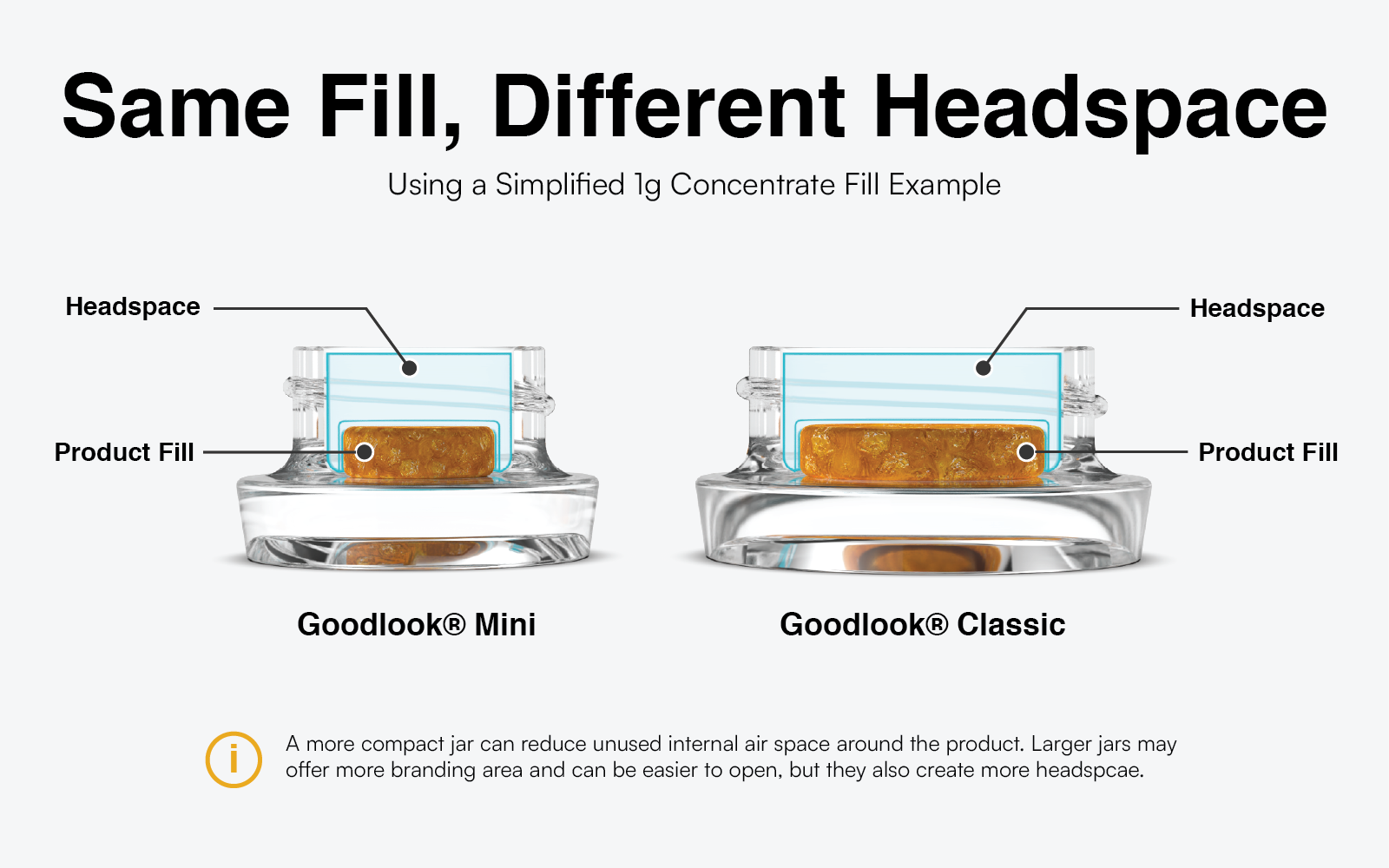
Headspace is the unfilled volume inside a package after the product has been added and the container has been closed.
Imagine placing the same one-gram fill into two jars: one compact jar with an internal volume close to what the product needs, and one much larger jar with substantial empty space above and around the product.
If both are capped with ordinary ambient air inside, the larger headspace contains a larger volume of that air. All else being equal, that means a larger initial reservoir of oxygen inside the package.
Oxygen matters because cannabinoids, terpenes and other cannabis constituents can undergo oxidative changes during storage. Temperature, light, time, seal quality and the package itself also affect stability, so headspace should not be treated as the only variable. But there is little benefit in pretending the amount of air enclosed around a product is irrelevant.
Why Some Brands Prefer Larger Concentrate Jars
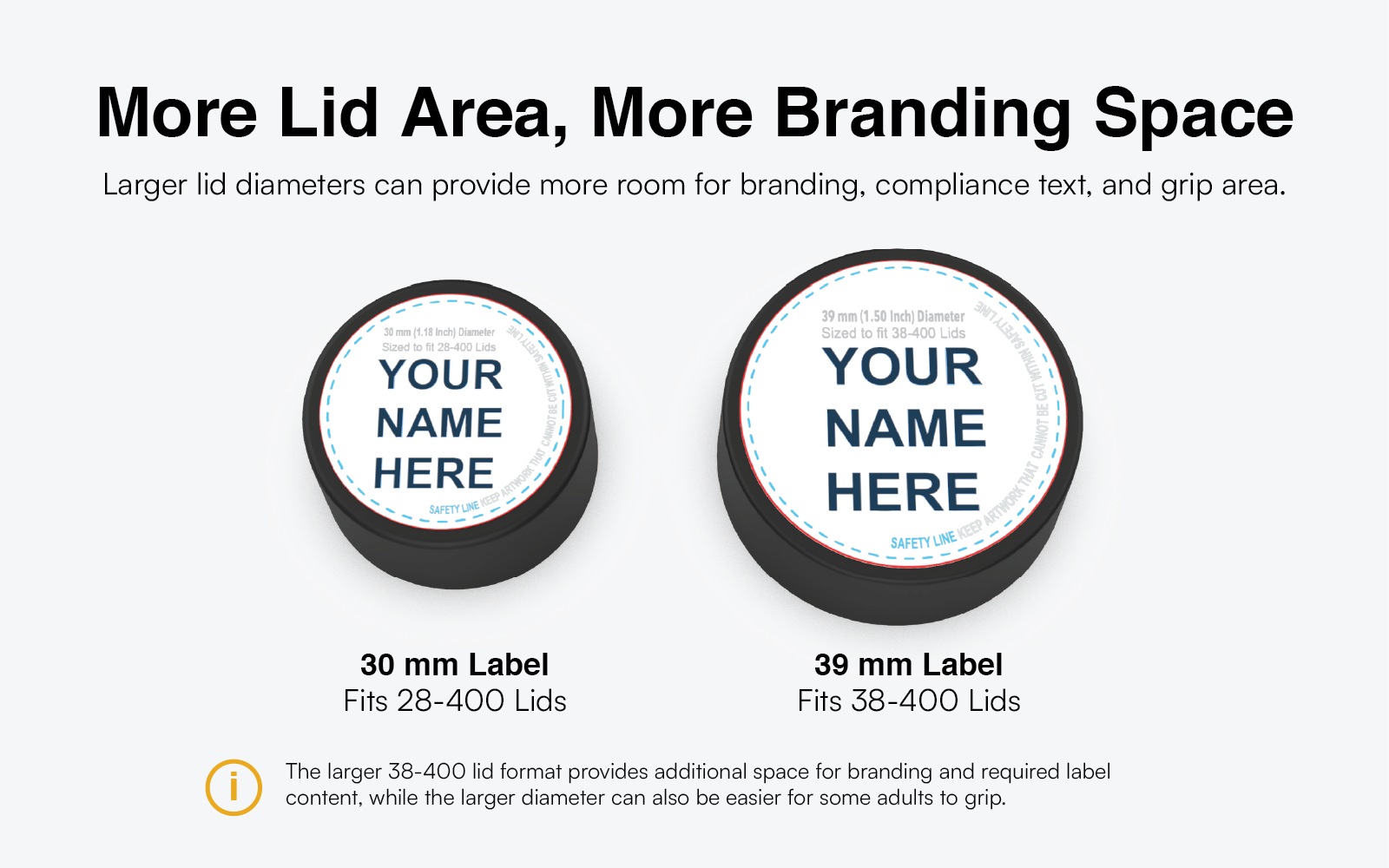
Headspace is only one side of the decision. Many brands intentionally use larger jars for relatively small fills because a larger package can provide valuable branding, labeling, merchandising and usability advantages.
More room for branding & required information
A larger jar and closure can provide more space for:
- lid-top branding
- sidewall or tamper-evident labels
- product identification and batch information
- state-required symbols, warnings or other mandated copy
- a larger visual footprint at retail
This can matter especially when the jar itself needs to carry most of the branding and required information without relying on an outer box.
More room around the product
Some brands prefer a larger cavity because it can make the product easier to inspect or access, particularly with concentrate formats that are chunky, crystalline or spread across a larger area.
Larger child-resistant closures can be easier for some adults to operate
A larger closure does not automatically mean an easier child-resistant package. Actual opening effort depends on the closure mechanism, application torque, push-down force, hand strength and package configuration.
However, closure usability is a real design consideration. The U.S. CPSC special-packaging protocol in 16 CFR § 1700.20 evaluates both child resistance and adult usability. The adult panel includes people ages 50–70, and the protocol requires at least 90% of adults to be able to open the package within the specified test period and, where applicable, properly resecure a second package.
In our own discussions around closure testing, smaller-diameter child-resistant caps came up as a potential usability challenge for some older users. A larger-diameter closure provides more surface area to grip and a larger turning radius, which can make it easier for some adults to hold and operate.
That gives the larger 38-400 closure used with Goodlook® Classic a practical ergonomic advantage over a more compact closure for some users, even though the actual opening force still depends on the complete package.
3ml vs. 5ml Concentrate Jars
Why choose a 3ml jar?
- compact internal volume
- reduced unused headspace for small fills
- smaller package footprint
- easy portability and storage
- efficient single-gram presentation
Why choose a 5ml jar?
- familiar industry format
- established supplier ecosystem
- additional internal room
- existing closures, labels or cartons may already be built around it
Goodlook® Mini: a compact 3ml format in a familiar small-package ecosystem
The Goodlook® Mini 3ml glass concentrate jar is intentionally designed around common 5ml-style concentrate-packaging footprints while using a smaller internal cavity. It is not a 5ml jar renamed as a 3ml jar—it is a compact 3ml container designed to work within a familiar small-format packaging ecosystem.
7ml, 8ml & 9ml Concentrate Jars
7ml and 9ml jars generally occupy the larger end of common concentrate packaging. Brands may move into this class because they want more internal capacity, more room around the product, greater branding area, a larger closure, more shelf presence or flexibility for larger fills.
But “7ml” and “9ml” are not universal external dimensions. Different manufacturers can create different geometries within the same nominal capacity. The actual package still needs to be evaluated by its measurements, neck finish and closure system.
Where an 8ml jar fits
The Goodlook® Classic 8ml glass concentrate jar has an 8ml nominal internal capacity while being designed around the larger packaging class commonly associated with 7ml and 9ml concentrate jars.
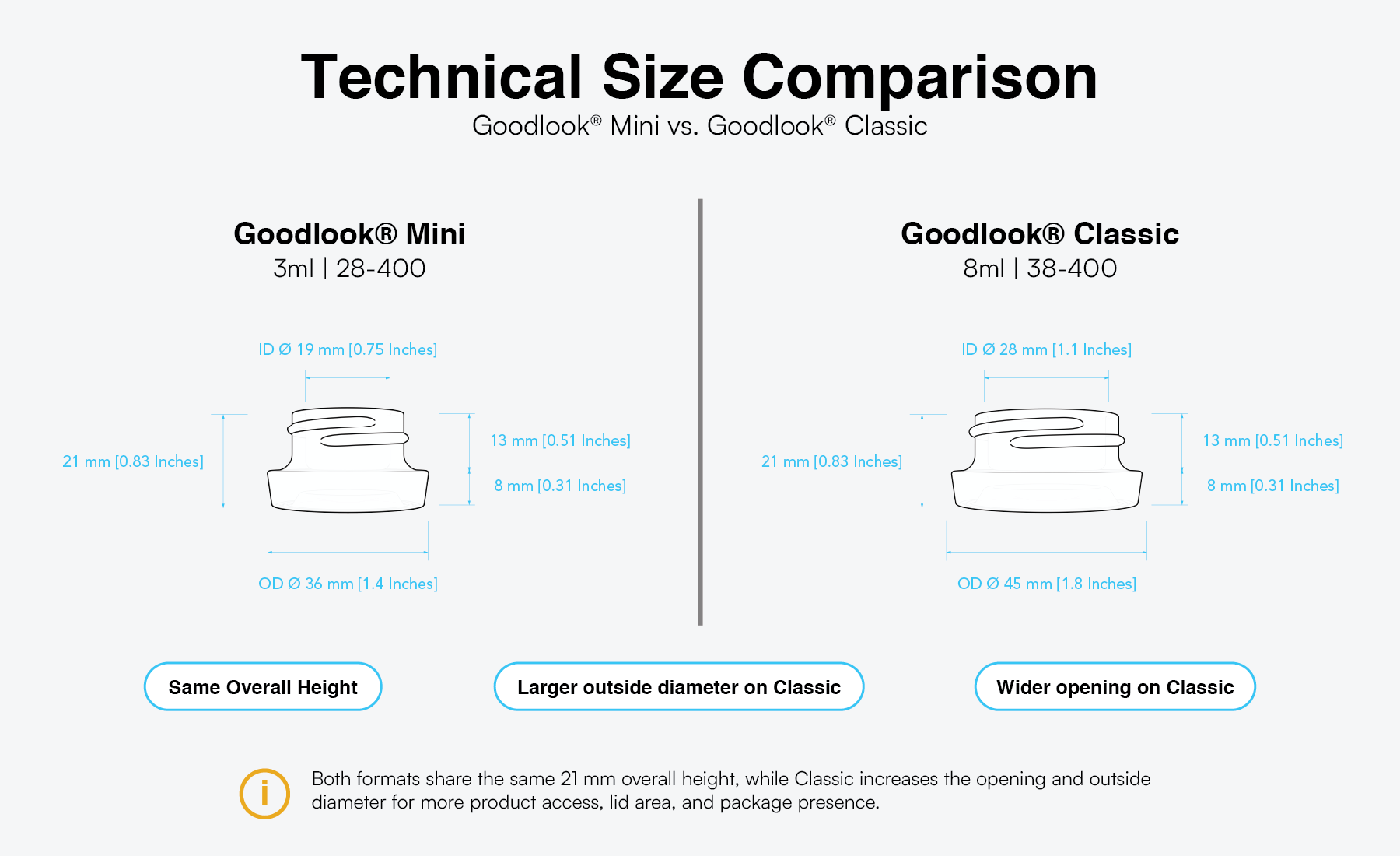
The Classic gives brands more internal room and a larger package surface while retaining the same low 21mm jar height as Mini. The larger diameter also creates more visual presence and provides a larger 38-400 closure platform for lid branding.
Why Goodlook® Uses a Magnifying Base
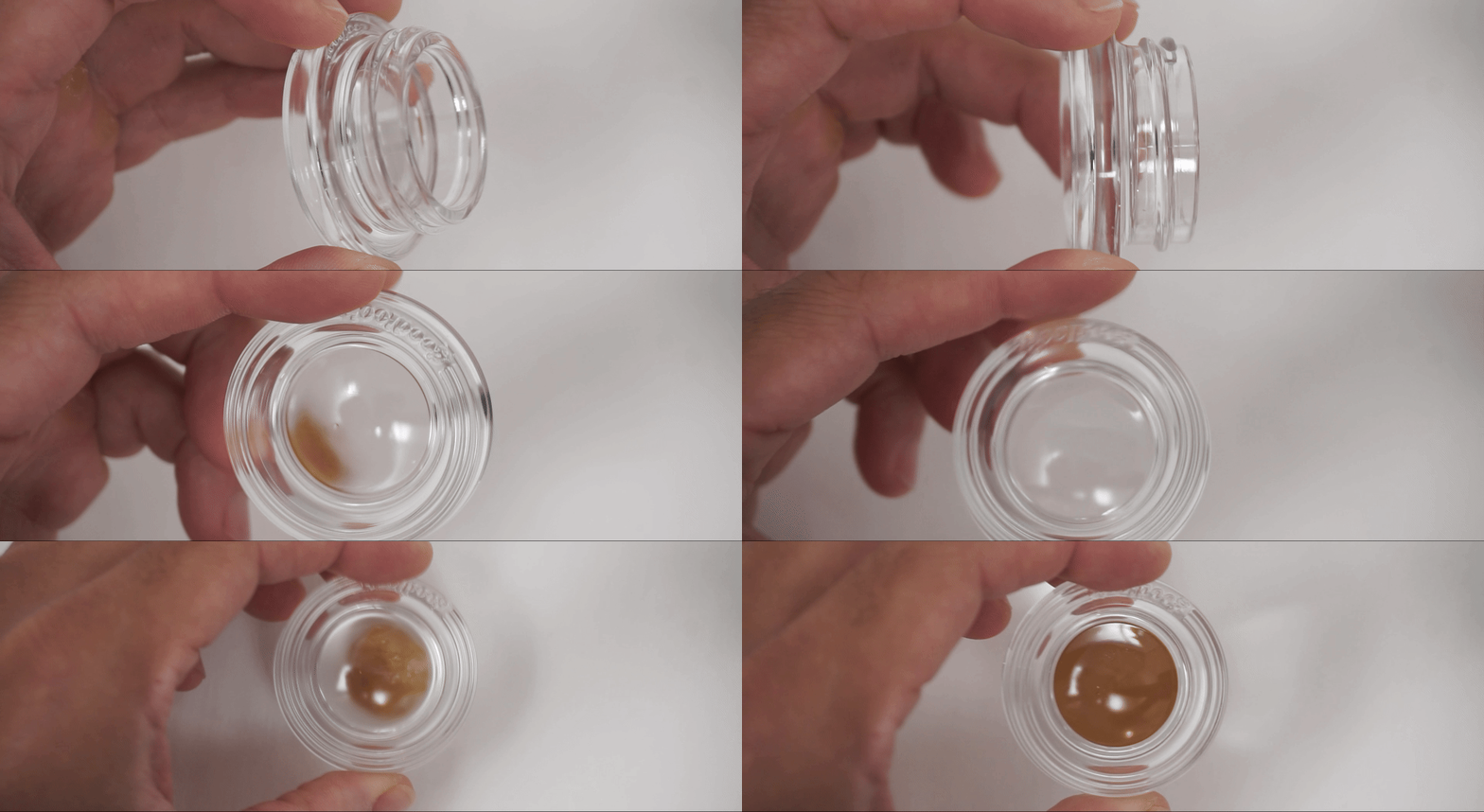
Mini and Classic are different sizes, but they share the same core Goodlook® design idea: a patent-pending magnifying base molded into the glass jar itself.
Concentrates are visual products. Color, clarity, crystal structure, texture and overall appearance can all be part of how a customer evaluates what is inside the package. The molded base creates a subtle magnifying effect when the jar is viewed from below, giving the customer a closer look at the product without requiring a separate optical insert or accessory.
One of the advantages of this approach is that the magnifying effect comes from the shape of the glass jar itself. There is no separate lens, insert, coating or added optical component to assemble.
Built into the geometry
The feature can add meaningful visual differentiation for brands and a more interesting viewing experience for customers without adding the kind of manufacturing complexity or component cost that a separate optical feature would normally require.
Same Goodlook design language
Mini uses the effect in a compact 3ml format. Classic uses the same visual idea in a larger 8ml package with more branding and presentation area.
The magnifying base is not intended to change the concentrate or claim that the product itself is better. It is a packaging-design feature intended to improve visibility and presentation while giving brands an added point of differentiation.
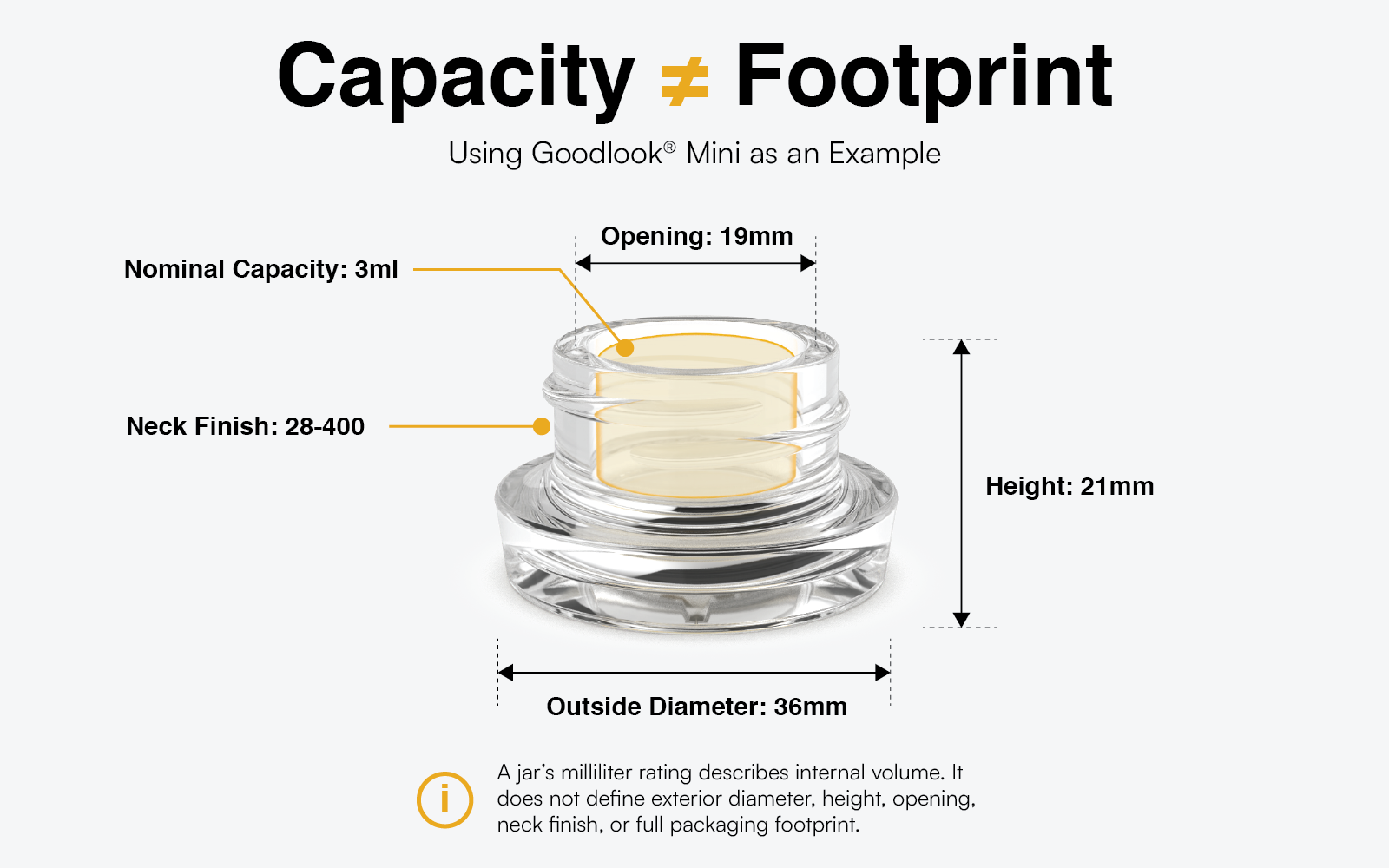
Jar Capacity vs. Jar Footprint
One of the most important distinctions in concentrate packaging is the difference between capacity and footprint.
Internal capacity
The volume available inside the jar. This is where measurements such as 3ml, 5ml, 7ml, 8ml and 9ml come from.
Exterior footprint
The physical size and geometry of the jar: outside diameter, height, opening and capped dimensions.
Packaging footprint
The complete package includes more than the jar:
Changing one component can affect everything downstream. A different jar might require a different closure, label, tamper seal, insert, box, artwork or packing procedure.
One outer box can support more than one jar footprint
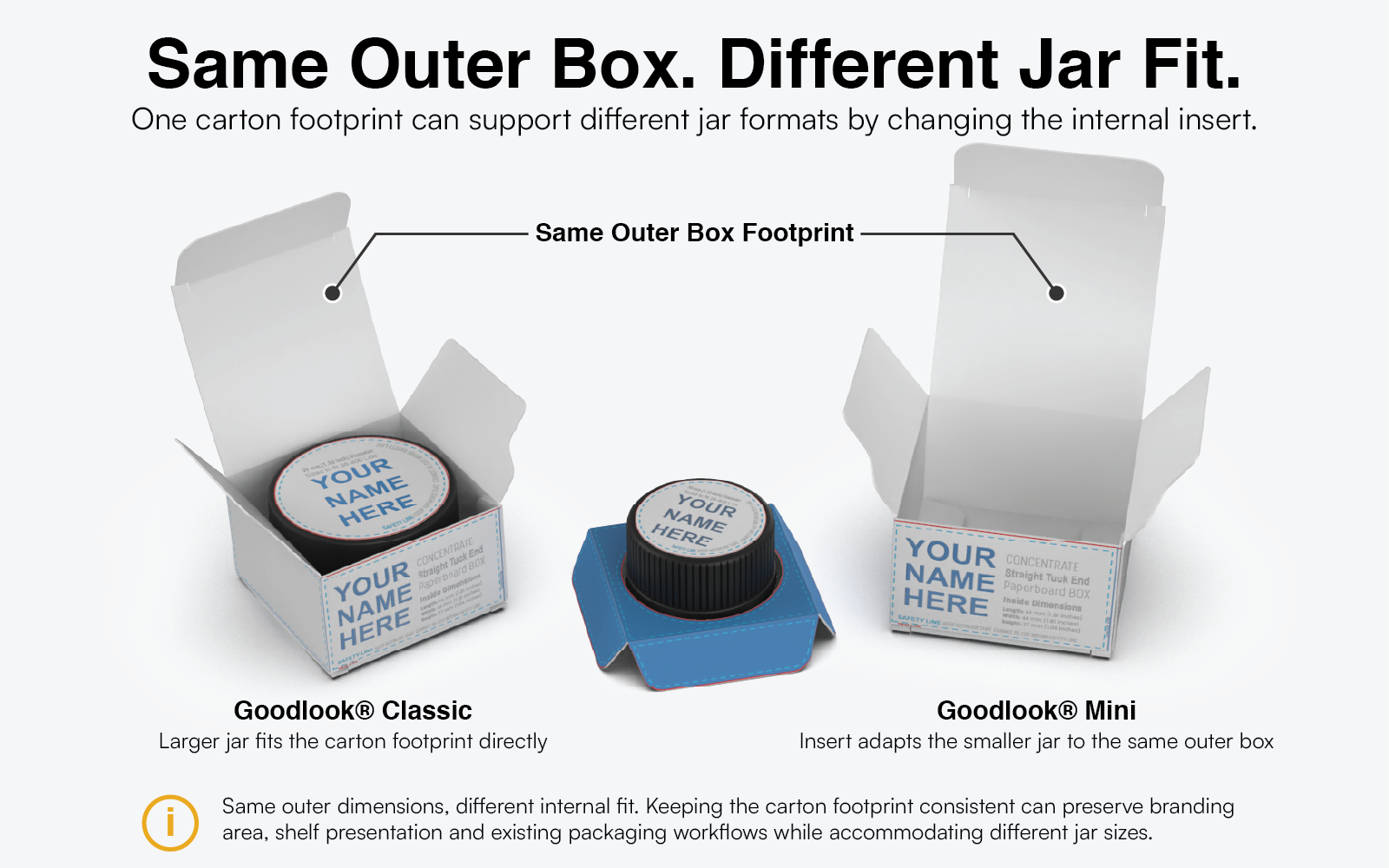
Makerbaus's current concentrate-box system is intentionally designed so the outer carton dimensions can remain the same across the Mini- and Classic-oriented packaging formats.
The larger Classic-format jar can use the box footprint directly, while the smaller Mini-format jar uses an insert to position the compact jar inside that same outer carton size.
For brands that already have artwork, shelf plans, shipping cases or retail presentation built around a specific carton size, that can simplify packaging changes considerably. It also gives brands a way to combine the compact advantages of Mini with a larger outer carton when they still want more branding area or room for required information.
What to Measure When Switching Concentrate Jars
If you are changing jar suppliers or comparing formats, verify at least:
- Outside diameter
- Overall jar height
- Mouth/opening diameter
- Neck finish
- Thread compatibility
- Capped package height
- Closure outside diameter
- Lid-top label area
- Sidewall label area
- Insert opening
- Interior box dimensions
- Desired headspace
- Actual product fill
Even if two containers are both marketed as “5ml concentrate jars,” that does not mean every dimension will match.
28-400 vs. 38-400 Concentrate Jar Closures
Nominal jar capacity does not determine lid compatibility. The neck finish does.
28-400
The compact Goodlook® Mini uses a 28-400 neck finish. Makerbaus offers matching 28-400 child-resistant concentrate jar lids and 30mm lid-label options.
38-400
The larger Goodlook® Classic uses a 38-400 neck finish. Makerbaus offers matching 38-400 child-resistant concentrate jar lids and 39mm lid-label options.
For both closure classes, see our child-resistant concentrate jar lids.
For a deeper explanation of neck finishes, cap dimensions, and compatibility, see our guide to 28-400 vs. 38-400 concentrate jar lids.
Because liner construction can also affect product contact, compression, and sealing behavior, see our guide to understanding concentrate jar liners for a deeper look at foil-faced, foam, PTFE, first-open seal, and reclosure systems.
How Concentrate Consistency Affects Jar Choice
| Concentrate format | Packaging considerations |
|---|---|
| Rosin | Actual fill volume, headspace, access and presentation |
| Live resin | Consistency, headspace and liner/closure interaction |
| Badder / budder | Tool access and cavity geometry |
| Diamonds | Crystal dimensions, sauce fraction and fill geometry |
| Wax | Fill shape and product access |
| Hash | Physical fill volume and desired presentation |
These are considerations, not hard rules. The correct decision comes from testing the actual product in the complete package.
Don't Choose the Jar Without Choosing the Packaging System
A jar is only one component of the finished package. Makerbaus organizes the Goodlook system around those relationships:
Primary packaging
Branding & secondary packaging
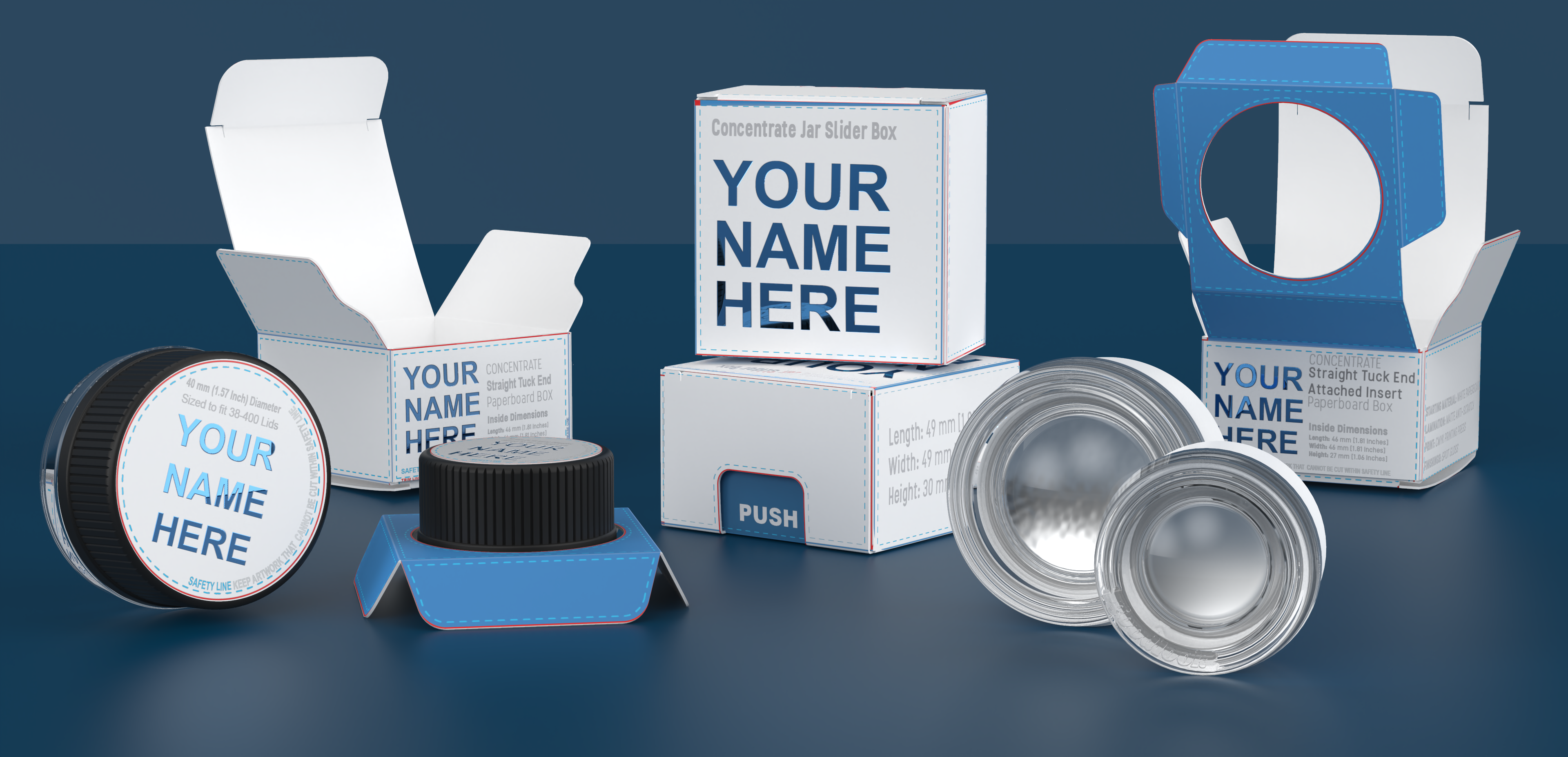
The insert is especially important when comparing Mini and Classic. Makerbaus's current concentrate-box dielines use the same outer box dimensions across the system. The larger-format jar can use that carton footprint directly, while Mini-oriented boxes use an attached or detached insert to locate the smaller jar inside the same outer carton.
That means a brand can choose a more compact primary container without necessarily giving up the larger branding area of the outer box.
Goodlook® Mini vs. Goodlook® Classic
| Feature | Goodlook® Mini | Goodlook® Classic |
|---|---|---|
| Nominal capacity | 3ml | 8ml |
| Outside diameter | 36mm | 45mm |
| Height | 21mm | 21mm |
| Opening | 19mm | 28mm |
| Neck finish | 28-400 | 38-400 |
| Packaging class | Common 5ml-style | Common 7–9ml-style |
| Case quantity | 250 | 250 |
| Tray pack | 5 × 50 | 5 × 50 |
| Magnifying base | Yes | Yes |
| Primary packaging advantage | Compact cavity, portability and reduced unused headspace | Larger branding/compliance area, package presence, capacity and larger closure |
Choose Goodlook® Mini when...
- you want a compact package
- you want a tighter cavity for small fills
- you want less unnecessary headspace
- portability and storage efficiency matter
- you want a 28-400 packaging system
Choose Goodlook® Classic when...
- you want more internal capacity
- you want a larger lid and branding surface
- you need more room for symbols, warnings or variable information
- you want a larger retail presence
- you want a 38-400 packaging system
- a larger closure may improve grip for some adult users
How to Choose Your Concentrate Jar Size
1. Start with the actual fill
How much physical volume does the concentrate occupy? Do not select the jar based only on gram weight.
2. Decide how much headspace you want
Do you want a compact product-to-package ratio or intentionally more room around the product?
3. Consider oxygen exposure
If minimizing unnecessary enclosed air is a priority, compare the headspace remaining after the actual fill is placed in each candidate jar.
4. Decide how much branding area you need
Consider lid labels, sidewall labels, tamper evidence, required copy and whether the jar will be sold with or without an outer carton.
5. Identify the closure system
28-400, 38-400 or another neck finish? The neck finish determines closure compatibility.
6. Verify downstream components
Check the actual lid, label, insert and carton—not just the jar specification.
7. Order samples before production
The best specification sheet cannot replace a physical packaging test. Fill the actual concentrate into the jar, apply the intended closure, check the label, place it in the insert and box, and verify the complete package before committing to production quantities.
Frequently Asked Questions
What size concentrate jar holds 1 gram?
A compact 3ml or common 5ml-style jar can often accommodate a 1-gram concentrate fill, but actual fit depends on product density, consistency and jar geometry. Test the actual product before production.
Is a 3ml jar large enough for 1 gram of concentrate?
It can be. Goodlook® Mini is designed around an approximately one-gram use case, depending on the density and consistency of the concentrate being packaged.
Why use a 3ml jar instead of a 5ml jar?
Potential reasons include less unused internal volume, reduced headspace for the same small fill, a more compact package and easier portability. A brand may still prefer 5ml when it wants additional room or already has an established 5ml packaging system.
Why would a brand use a larger jar for one gram?
A larger jar can provide more branding area, a larger lid, more shelf presence and more room around the product. The extra label surface can also be useful when a brand needs to fit universal symbols, warnings, product identification, batch information or other required copy directly on the primary package. Larger closures may also be easier for some adults to grip and operate.
Does headspace affect concentrate quality?
Headspace determines how much gas surrounds the product inside a sealed package. When a jar is capped with ambient air, more headspace generally means more air—and therefore more oxygen—is initially enclosed. Oxygen can participate in degradation pathways affecting cannabinoids and terpenes, but package performance also depends on sealing, light, temperature, permeability, product composition and storage time.
Is less headspace always better?
No. Reducing unnecessary headspace can reduce the amount of ambient air enclosed around a small fill, but larger packages may offer meaningful benefits in branding area, access, presentation and capacity.
Are larger child-resistant lids easier to open?
They can be easier for some adults to grip because a larger-diameter closure provides more gripping surface and a larger turning radius, but actual opening effort depends on closure design and applied torque. U.S. CPSC special-packaging testing explicitly evaluates adult usability as well as child resistance, including an adult panel ages 50–70.
What is the difference between a 5ml and 9ml concentrate jar?
The nominal internal capacity differs, but the exterior dimensions, closure size, label area and packaging footprint can also differ. Compare actual specifications instead of assuming volume alone describes the package.
Are 7ml and 9ml concentrate jars the same size?
No. Nominal capacity is not a universal exterior-size standard. Even jars with the same stated capacity can use different geometries.
What does 28-400 mean?
28-400 is a container neck-finish designation used to match a jar with a compatible closure. Goodlook® Mini uses a 28-400 neck finish.
Can I use the same lid on 5ml and 9ml concentrate jars?
Only if the jars use the same compatible neck finish. The nominal volume of the jar does not determine closure compatibility.
Do all 5ml concentrate jars fit the same boxes?
No. Exterior diameter, height and capped dimensions can vary between manufacturers. Verify the actual jar and closure against the insert and box dimensions.
Should I choose the jar or the box first?
In most cases, validate the primary container and closure first, then build the label, insert and outer box around the confirmed package dimensions.
What size jar is best for rosin?
There is no universal jar size for rosin. Consider actual fill volume, desired headspace, tool access, branding area, closure system and outer packaging.
Why does Goodlook use 3ml and 8ml sizes instead of 5ml and 9ml?
Goodlook® is designed around packaging goals rather than simply copying common nominal capacities. Mini uses a compact 3ml cavity within a familiar small-format packaging ecosystem, while Classic provides an 8ml cavity within the larger 7–9ml packaging class.
The Bottom Line
Choosing a concentrate jar is not simply choosing a number of milliliters. You are choosing the internal volume surrounding the product, the amount of unused headspace, the closure system, the physical size of the package, the available branding area, the insert and box requirements, the way the package feels in the user's hand and the way it presents at retail.
For some brands, the best answer is a compact jar that minimizes unnecessary volume and is easy to carry and handle. For others, the best answer is a larger jar that provides more room, a bigger branding canvas, more space for required information and a larger closure.
Goodlook® Mini and Classic use different dimensions to solve those different packaging goals, while sharing the same patent-pending magnifying-base design.
Sources & Technical Notes
- Bueno J, Alborzi S, Greenbaum EA. Vapor Phase Terpenes Mitigate Oxidative Degradation of Cannabis sativa Inflorescence Cannabinoid Content in an Accelerated Stability Study. Cannabis and Cannabinoid Research. PMID: 35384716.
- MacLaughlin LL, MacDonald MT. Is nitrogen-modified atmosphere packaging a tool for retention of volatile terpenes and cannabinoids in stored Cannabis sativa inflorescence? Journal of Cannabis Research. PMID: 39707520.
- U.S. Consumer Product Safety Commission — Special Packaging (PPPA) FAQs. CPSC guidance describes special packaging as child-resistant while remaining relatively easy for adults to open and summarizes the adult-friendly test requirements under 16 CFR § 1700.20.
Note: these sources support the general storage/oxidation and special-packaging concepts discussed above. They are not package-specific validation of Goodlook® jars or a quantified shelf-life claim. Cannabis packaging and labeling requirements vary by jurisdiction.
Tags: